of computing power of the world’s 500 largest AI supercomputers sits in one country
NeedIndependent International Scientific Panel on AI (2026)
Data, languages and cultural heritage
The sovereignty gap
Private investment in AI infrastructure approached half a trillion dollars last year. Public investment in AI capacity for developing countries is, by comparison, “a rounding error”. The AI divide risks becoming “a development gap, a security gap and a sovereignty gap”.*
* Source: UN Secretary-General, Global Dialogue on AI Governance, Geneva, 6 July 2026 (United Nations, 2026).
Opportunity for action
Members can accelerate in partnership
Keep sensitive learner data under national jurisdiction, and adapt open AI models to national languages and curricula through Commonwealth partnerships.
The argument
AI sovereignty is an extension of national responsibility for education, citizens’ data and cultural heritage. Countries need the capacity to decide what AI systems learn, how they are used and who is accountable. Today, about 75% of the computing power of the world’s 500 largest AI supercomputers sits in one country and 15% in another, and most countries lack the expertise to assess frontier models (Independent International Scientific Panel on AI, 2026).
Share of the total computing power of the world’s 500 largest known AI supercomputers, by the country where they are located, 2025
Source: Independent International Scientific Panel on AI (2026), Preliminary report, pp. 8 and 16, drawing on Pilz et al. (2025), whose 500 systems hold about a tenth of all AI chip performance. Where a supercomputer sits does not by itself determine who can use or own it.
| Category | Value |
|---|---|
| in one country | 75% |
| in another country | 15% |
| in the rest of the world, including every Commonwealth Member Nation | 10% |
Sovereignty does not mean isolation: no country owns the whole AI supply chain. A practical approach is a hybrid one, where non-sensitive tasks can use external cloud services while learner records, assessments and administrative data stay on nationally governed systems under domestic law. Drawing on several AI suppliers also reduces exposure to price changes, export controls and outages.
Sovereignty is also critical for language and culture. Some open models now work across 140 languages, yet models trained mainly elsewhere may poorly reflect national curricula and local languages, and exclude Indigenous Knowledge. Open models can be further trained on authorised local material, with communities deciding what is used and how knowledge is represented (Lewis, 2020). Japan’s experience shows that such adaptation can improve performance in a national language without building models from scratch (Fujii et al., 2024).
Proof points
Each card represents evidence in a strategic talking point, chosen because it shows the need or a result of COL’s work. Use the share button to copy a card as an image with a link back to this page.
of computing power of the world’s 500 largest AI supercomputers sits in one country
NeedIndependent International Scientific Panel on AI (2026)
countries with cohorts of the Commonwealth Student Community for AI Governance by August 2026
ResultCOL
Case study
In February 2026, the India Student Community for AI launched within the GPAI community, and over 60 students joined its AI Impact Summit satellite event. With support from COL and its Commonwealth Educational Media Centre for Asia, and GPAI expert centres in Canada, France and Japan, it has become the Commonwealth Student Community for AI Governance, with cohorts in more than 20 countries by August 2026.
The community works through four pillars: national student coalitions, interdisciplinary research, evidence-based policy advocacy and institutional reform, from curricula to academic standards.
Language and data sovereignty run through every cohort’s agenda. In Sri Lanka, students working with the Ministry of Education prioritise Sinhala and Tamil language technology with human oversight. Kenyan students are developing Kiswahili voice AI and, in August 2026, submitted a memorandum on the draft national AI policy calling for a youth seat on the National AI Council, subsidised computing for academic research and a right to explanation for automated decisions.
In Pakistan, students at Allama Iqbal Open University are working on tiered AI policy and rural AI labs; Maldivian students focus on Dhivehi; Australian students on safeguards for Indigenous cultural and intellectual property; and African and Caribbean cohorts on open-source tools in local languages, shared climate-prediction tools and cultural data sovereignty.
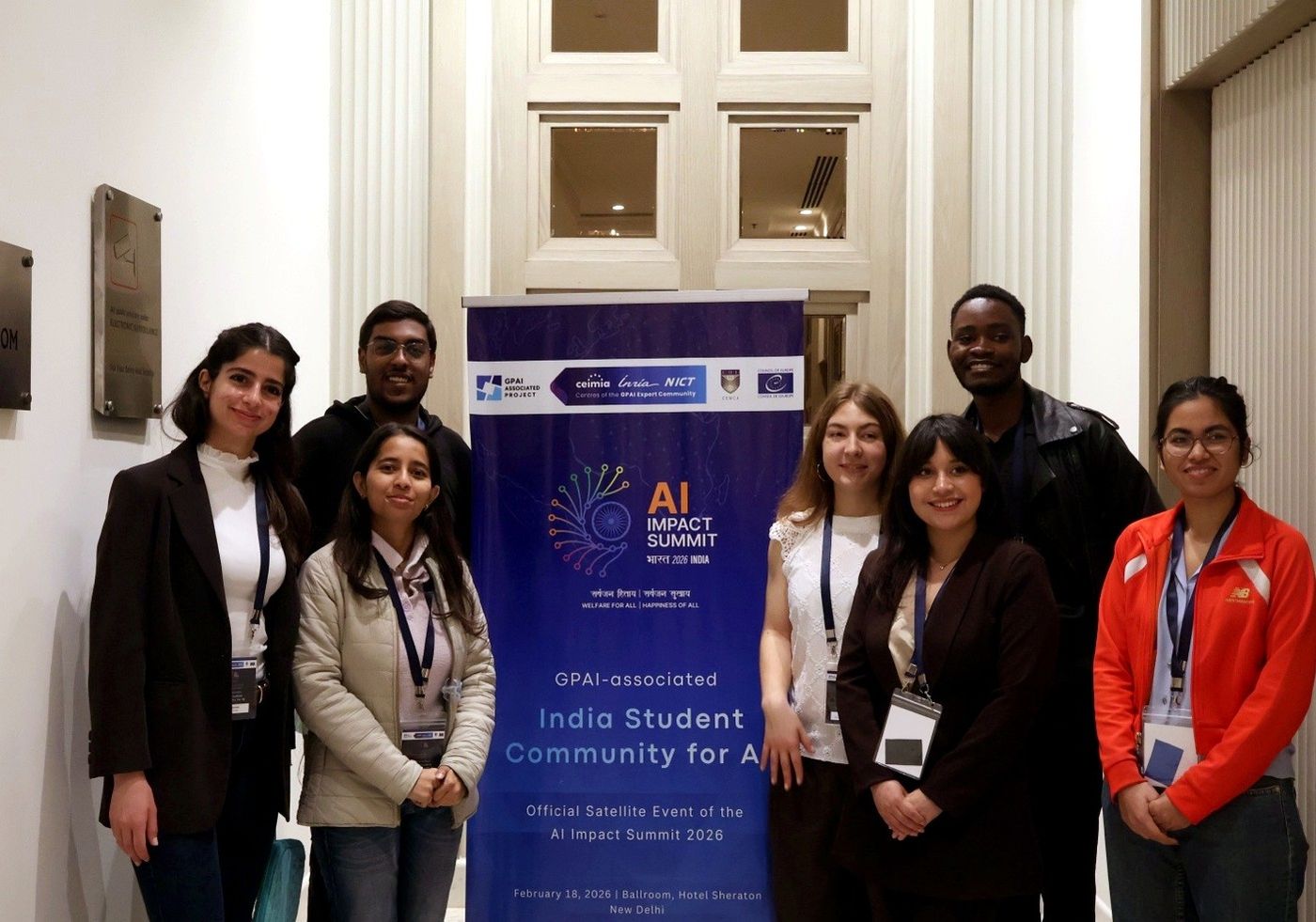
Member Nations with a documented national or regional cohort of the Commonwealth Student Community for AI Governance, by launch date, February to October 2026. Select a date or a country.
Sources: the talking point (each cohort’s focus, in its words); COL-CEMCA’s announcements of each launch, 20 February to 19 October 2026 (CEMCA news). Only Member Nations named in those announcements are counted; COL-CEMCA itself reported ‘over 23’ nations by 21 August, so the full count may be higher.
Their message is consistent: open-source language technology can counter algorithmic bias and the neglect of local priorities. These views can inform the Commonwealth Youth Forum, whose outcomes will be presented at CHOGM in St John’s.
Regional policy is moving the same way. In the Caribbean, a regional AI task force has called for a harmonised, rights-based framework, a Caribbean data commons and resilient regional computing.
University partnerships supported by COL, including through the Gaborone to New Delhi Compact (COL, 2026), can pool computing capacity, expertise and methods, so smaller countries can take part while retaining control of their data and cultural resources.
A hybrid, sovereign approach
Places of impact
8 of the 56 Member Nations. Every member is one equal tile, so small states stay visible; select a tile to read what happens there.
Opportunity for action
Members can accelerate in partnership
Milestones
Identify national focal points for education data and AI to work with Commonwealth partners.
Start classifying which education data may use external services and which must stay on national systems.
Universities join Compact partnerships and begin adapting open models to national languages and curricula, with community consent.
UniversitiesCompact partnershipsWe continue to act
COL will broker university partnerships, share methods and the reference architecture, and support young people’s voice in AI governance.
From the newsroom
Stories from the Commonwealth of Learning that highlight this strategic talking point. Each opens on col.org.
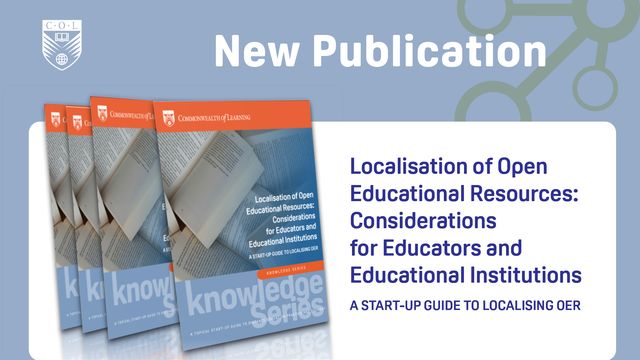
COL has published a Knowledge Series guide on localising open educational resources that highlights Indigenous knowledge and community languages, and cautions that AI-supported localisation needs ongoing human oversight.
“The guide also notes AI’s potential to support localisation, while cautioning that certain languages and knowledge systems are poorly represented in training data.”
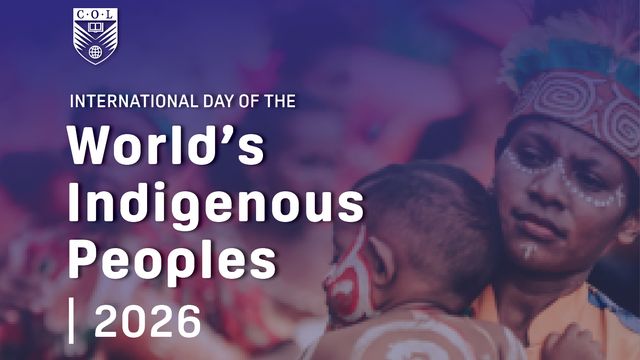
On the International Day of the World’s Indigenous Peoples, COL calls for OER involving Indigenous knowledge to be co-designed with knowledge holders, and for Indigenous data sovereignty to guide AI tools and OER platforms.
“Indigenous data sovereignty should guide learning analytics, AI tools, and OER platforms.”
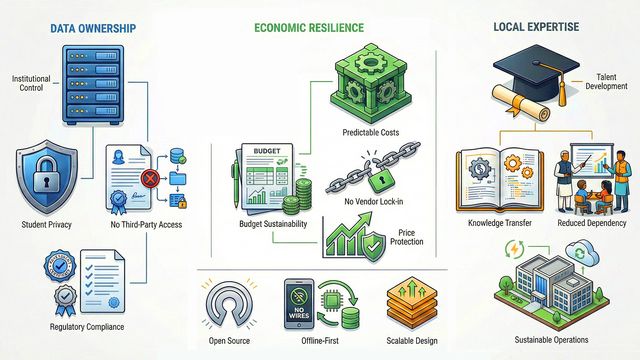
COL’s Frugal AI reference architecture uses open-weights models where appropriate; properly designed, locally hosted AI can help institutions keep learner records within national or institutionally controlled systems, and COL’s AI-agent trials follow a Teacher-in-the-Loop approach.
“Institutions and agencies in Mauritius, Malaysia, Samoa and Vanuatu have formally engaged with COL’s Frugal AI work, and capacity building is under way with the Higher Education Commission of Mauritius.”
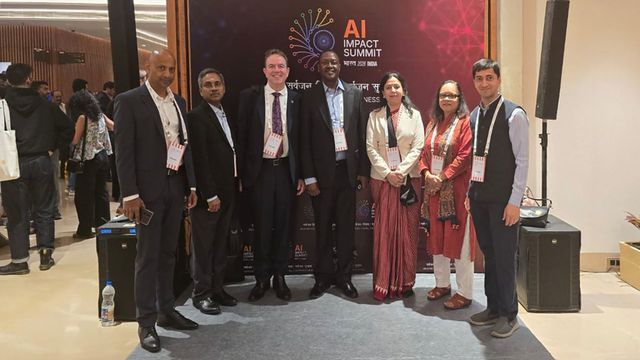
COL launched the Gaborone to New Delhi Compact on teacher-led, localised Frugal AI at the India AI Impact Summit 2026, and leaders from Fiji, India, Kenya and Mauritius endorsed the approach.
“More than a policy statement, the Compact provides a blueprint for “sovereign, private, and secure” AI that aligns with national regulatory frameworks and systematically builds domestic capability.”
COL's Frugal AI framework prioritises open-weight models on local-first infrastructure and keeps education data under local jurisdiction; its offline-first Teacher-in-the-Loop model has teachers approve AI output before it reaches learners.
“Frugality is the pathway; sovereignty is the destination.”
Working in synergy
This talking point aligns with the Commonwealth Secretariat’s Democratic pillar and the Commonwealth Foundation’s focus on freedom of expression.
Talking points on the same pillar
As printed in the talking point, followed by the further sources used for this site’s charts and diagrams.
Further sources for the charts and diagrams