

By Ricky Cheng, Knowledge Services Manager, COL
Why Locally Deployable AI Matters for Commonwealth Education
Recently, Google DeepMind released Gemma 4 12B, a 12-billion-parameter multimodal language model designed to run locally on laptop-class hardware with sufficient memory. The model supports text, image, and audio inputs, works across 140 languages, and is released under the Apache 2.0 licence, allowing broad use, adaptation, and deployment. While the release attracted little fanfare, it raises an important point for education across the Commonwealth: where AI runs matters.
That question of location is especially important for educational institutions. Many AI services are delivered through remote data centres and accessed by subscription over the internet. These services can be valuable, but they also depend on reliable connectivity, recurring payments, and data arrangements that may be difficult for public institutions to examine fully.
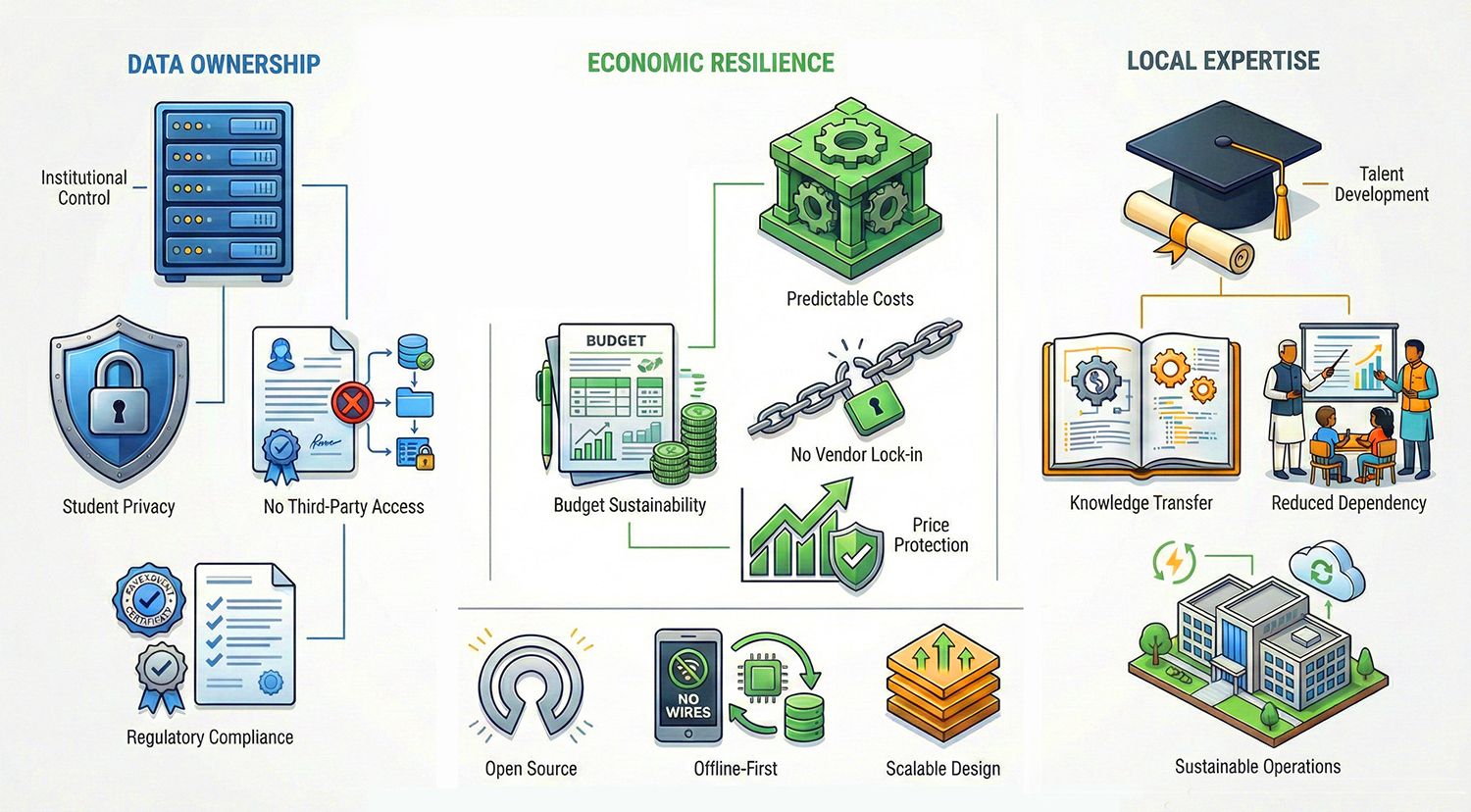
A capable open model running locally offers another pathway. It allows a teacher education college, open university, ministry, regulator or district resource centre to test AI-supported services on infrastructure under its own control. This does not replace all cloud-based services, but it gives institutions more choice and more room to govern AI in line with national law, public accountability and local educational needs.
This is the premise of the Frugal AI paradigm advanced by the Commonwealth of Learning (COL). Frugal AI asks what level of capability best serves a given educational task and how institutions can deliver that capability using the infrastructure they already have. COL’s Frugal AI reference architecture sets this out as a practical technology stack: open-weights models where appropriate, efficient inference software, retrieval over locally curated educational content, and applications designed around specific teaching, learning and administrative tasks.
Gemma 4 12B is one example of the wider movement that makes this architecture increasingly practical. It joins a growing family of open and locally deployable models produced by different organisations and regions. China-based entities have contributed efficient small language models, such as Alibaba’s Qwen3.5 Small family. These compact variants range from 0.8 billion to 9 billion parameters and are specifically optimised for reliable local deployment on the modest hardware already found in universities and public institutions. They can enable sovereign, cost-effective, and fully governable AI solutions tailored to national priorities. This diversity gives Commonwealth institutions the ability to compare models, choose tools suited to their tasks and avoid dependence on a single supplier or platform.
Local operation also strengthens the case for responsible data governance. If properly designed, locally hosted AI can help institutions keep learner records, teacher assessments and administrative data within national or institutionally controlled systems. This does not remove the need for data protection rules, access controls, audit logs and institutional safeguards. It does, however, make it more practical for countries and institutions to build AI services that respect data sovereignty from the outset.
COL is already putting this approach into practice with partners in several Commonwealth countries. Institutions and agencies in Mauritius, Malaysia, Samoa and Vanuatu have formally engaged with COL’s Frugal AI work, and capacity building is under way with the Higher Education Commission of Mauritius. The work includes reference applications, locally hosted demonstrations and a shared knowledge base on which models are suited to which purposes, what hardware is sufficient and how such systems can be governed responsibly.
Another important development is the rise of agentic AI. These are systems that can plan and carry out multi-step, long-running tasks. COL has begun trials of AI agents in education, applied to carefully defined tasks such as preparing lesson plans, adapting classroom activities or querying approved institutional knowledge bases. These trials follow COL’s Teacher-in-the-Loop approach, where teachers set the task, can intervene during the process, and approve what is finally used. Importantly, professional judgement remains with the professional.
The immediate opportunity is likely to be institutional rather than individual. In many Commonwealth contexts, not every teacher will have a personal computer capable of running such models. But a teacher education college, open university, ministry, district resource centre or public institution can host a local model on a suitable workstation or modest server and make AI-supported services available to the educators and learners it serves.
These developments make AI more accessible to institutions that may not have the resources to depend on large, externally hosted systems. Each new open and locally deployable model helps lower the barriers to participation and adoption. With careful governance, appropriate infrastructure and local capacity building, Frugal AI can help smaller institutions develop and deliver services that were previously beyond their reach.
COL welcomes institutions and partners who wish to join this work. Visit www.col.org/frugal and review the Gaborone–New Delhi Compact, which is open for signature.