By Dr Jako Olivier, Adviser: Higher Education, COL
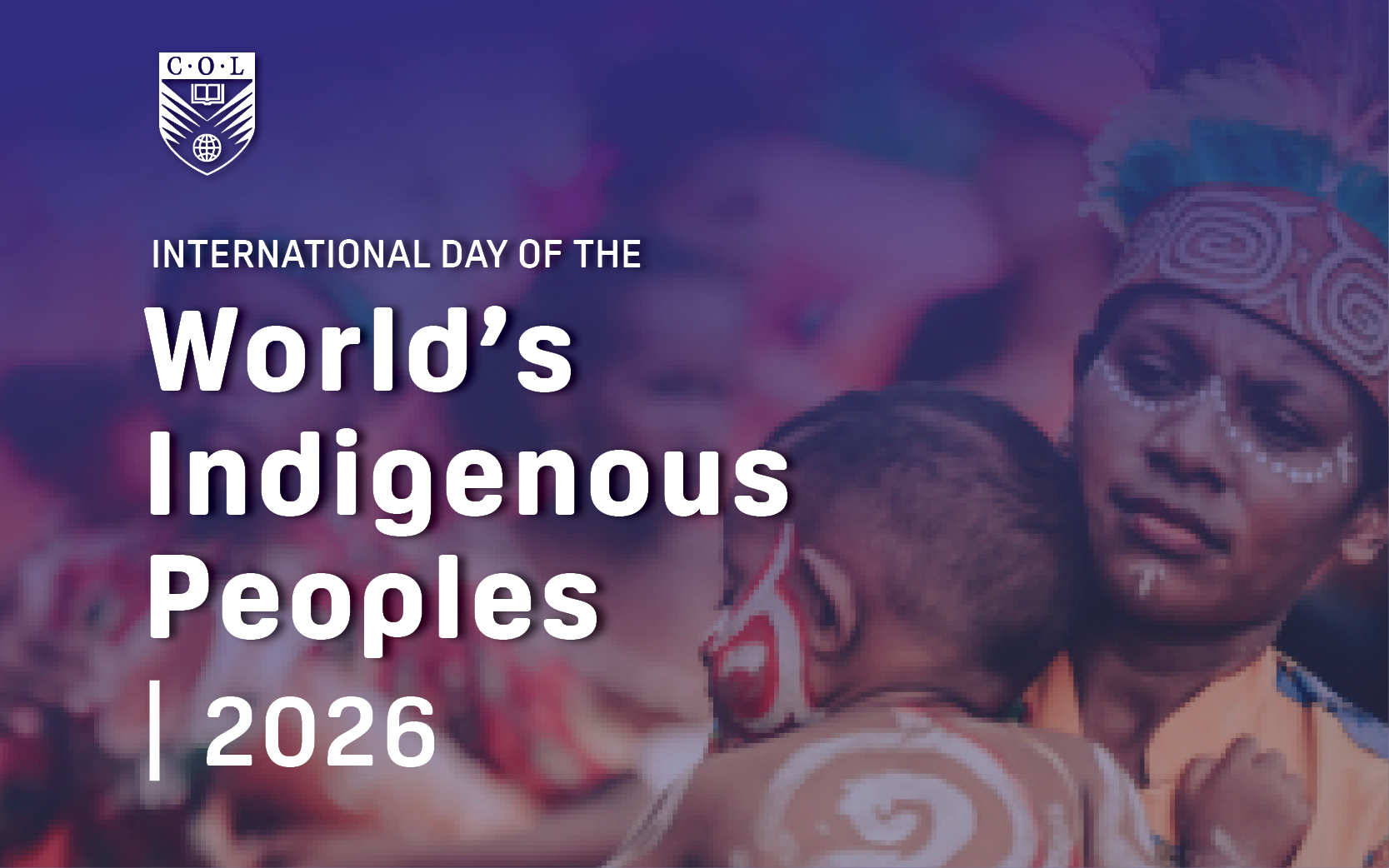
On 9 August every year, the International Day of the World’s Indigenous Peoples provides an opportunity for governments, educational institutions, learners, and the wider public to recognise the rights, cultures, and contributions of Indigenous Peoples. The Day calls on stakeholders to do more than celebrate diversity, urging us to listen, share authority, and support learning that protects Indigenous languages, land- and sea-based knowledge, and community futures.
Educators have a vital role to play in advancing this commitment. Teachers, curriculum developers, education leaders, and government officials can help shape policies and practices that ensure Indigenous knowledge is recognised as a legitimate and valuable part of teaching and learning.
Across diverse Commonwealth contexts, Indigenous knowledge is already being integrated into education in a variety of ways. In South Africa, for example, Indigenous Knowledge Systems are embedded in the national school curriculum and supported through instruments such as the national Indigenous Knowledge Systems (IKS) Policy, adopted in 2004. In Canada, Indigenous knowledge and perspectives are embedded across different subjects and grades in British Columbia, guided by the First Peoples Principles of Learning, while in Manitoba, schools are expected to incorporate Indigenous perspectives across the curriculum. Similarly, in New Zealand, mātauranga Māori, which encompasses Māori knowledge, norms, principles, and experiences, is incorporated into areas of the national curriculum. Measures such as these create opportunities for educators to connect formal learning with knowledge rooted in the Indigenous histories and cultures of their local contexts.
Beyond traditional schooling, Indigenous knowledge and languages also need to be considered in open and distance learning (ODL) contexts. At the Commonwealth of Learning (COL), we know that education is strongest when it is open and when it recognises the value of diverse forms of knowledge, including Indigenous knowledge systems, perspectives, and ways of knowing. This means recognising Indigenous knowledge not as content to be extracted, digitised, and redistributed without consent, but as living, relational knowledge that is often collectively held.
As an intergovernmental organisation and trusted convener of governments, institutions, and practitioners, COL approaches education with openness and regards education as a public good that needs to be affordable, adaptable, and accountable. COL recognises that ODL is most effective when local languages, local protocols, and community priorities, including those of Indigenous nations, guide its design. This work requires partnerships, capacity strengthening, and the responsible use of technologies that enable communities to decide what knowledge should be shared, how it should be used, and who will benefit. These efforts are central to equity, inclusion, and sustainable development in open education.
Open educational resources (OERs) can further support collaboration, capacity-building, and the scaling up of new models for knowledge creation while enabling the reuse of OER in ways that take Indigenous knowledge and languages into account. COL’s OAsis repository makes thousands of openly licensed publications and learning resources available for adaptation. With the input and collaboration of Indigenous leaders and educators, many resources can be adapted to reflect the local contexts and languages of the communities seeking to use them. More recently, COL also developed an open micro-course, Respecting Indigenous Rights and Practices: Ways to a Better Planet, which provides learning on Indigenous practices, rights, and environmental stewardship.
To advance the protection and integration of Indigenous knowledge into education more responsibly, educators, institutions, and policymakers should ensure, first, that OERs involving Indigenous knowledge are co-designed with Indigenous knowledge holders from the outset, with clear provisions for benefit-sharing and community review. Second, open licences need to be approached with care: some materials may be fully open, while other knowledge may require restricted access, contextual notes, or community protocols. Third, repositories should include relevant metadata on provenance, permissions, language, cultural context, and conditions of reuse.
Fourth, Indigenous data sovereignty should guide learning analytics, AI tools, and OER platforms. The CARE Principles and Canada’s First Nations Principles of Ownership, Control, Access and Possession (OCAP®) remind us that data governance is about collective benefit, authority, responsibility, and ethical use. In the Pacific, COL-supported open initiatives have helped ministries establish national OER collections and build more resilient education systems, including through approaches that respect data sovereignty. Finally, ODL should support offline, low-bandwidth, and multilingual pathways so that openness is not limited by connectivity.
On this day, COL reaffirms a practical commitment to ensuring that open education not only shares knowledge more widely, but also shares power more fairly, advancing the recognition and respect of Indigenous knowledge. This means creating space for Indigenous Peoples to shape how their knowledge is represented, shared, and sustained across generations. By listening to communities, strengthening partnerships, and designing learning with rather than simply for Indigenous Peoples, we can help ensure that openness in education is grounded in respect, reciprocity, and shared benefit.