

By Dr Jako Olivier, Adviser: Higher Education, COL
On 30 September, International Translation Day celebrates translators, interpreters and language professionals. Established by the United Nations General Assembly in 2017, the observance also invites reflection on the role of language in education: does making a resource available in a local language make it truly accessible to the learners it is intended to reach?
Open educational resources (OER) are teaching and learning materials available under open licences that permit reuse and adaptation. Localisation considers how resources can be adapted and made more relevant to learners’ own languages, cultures, and lived experiences. While translation is central to localisation, incorporating relevant examples, knowledge systems, and teaching approaches add incredible value. Consider a resource designed around urban life being used in a rural classroom. Translating its words may not make its examples meaningful, but adapting the resource to reflect local experiences could make it more meaningful and relevant to students.
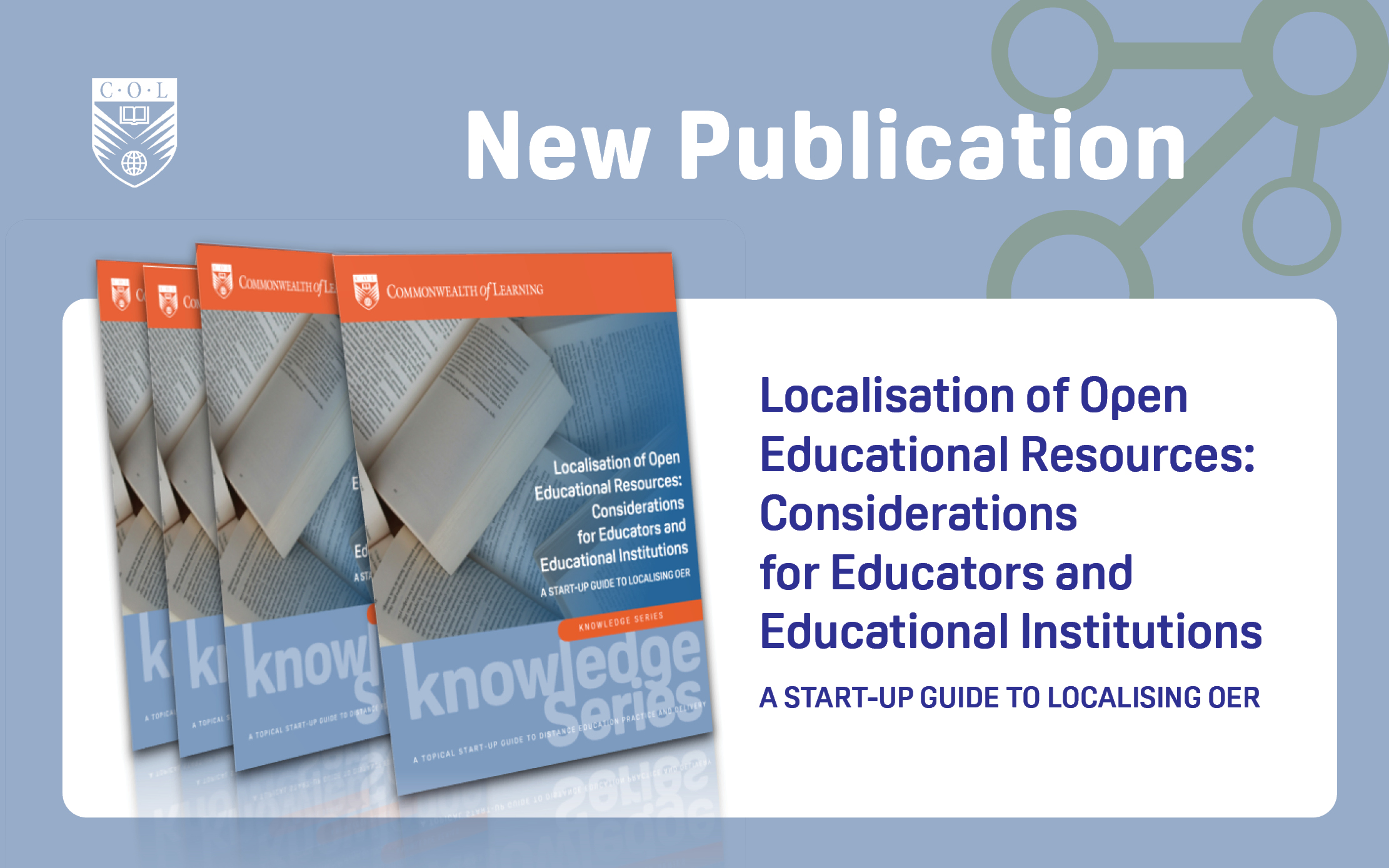
To support this work, the Commonwealth of Learning (COL) has published Localisation of Open Educational Resources: Considerations for Educators and Educational Institutions, a Knowledge Series guide by Professor Lynne Bowker and Dr Jako Olivier.
Covering both planned and more informal approaches to OER localisation, the resource highlights the role learners can play in contributing localised knowledge and makes the case for the value of informal approaches to OER localisation in contexts where resources are limited and community languages are rarely used for written material. A focus on recontextualisation also highlights the importance of Indigenous knowledge and invites critical questioning around whose perspectives are commonly represented in educational materials.
The guide provides practical advice on the use of open licensing and on designing resources that are easier to adapt across different contexts. Separating core content from examples and case studies, for instance, can help educators substitute material that is better suited to local needs without having to deconstruct an entire resource. The guide also notes AI’s potential to support localisation, while cautioning that certain languages and knowledge systems are poorly represented in training data. This reinforces the need for ongoing human oversight and careful review. Institutions are also encouraged to provide training and recognise educators’ contributions to the localisation process.
For COL, equitable access to quality learning through open, distance and technology-enabled approaches is central to advancing learning for sustainable development. This Knowledge Series publication reflects this commitment and the spirit of International Translation Day by recognising the people and expertise that help make knowledge accessible across languages and contexts. It also reminds us that language is an important part of ensuring that learners can engage with education in ways that are meaningful, relevant and rooted in their own communities.
On this occasion, we invite educators and institutions to explore the guide (https://doi.org/10.56059/11599/6149) and start with one resource. Bring learners and language professionals into the process, adapt it to local needs, review it together and share it under an appropriate open licence.
In doing so, we can move beyond making more content available towards learning that is truly inclusive, relevant and accessible.