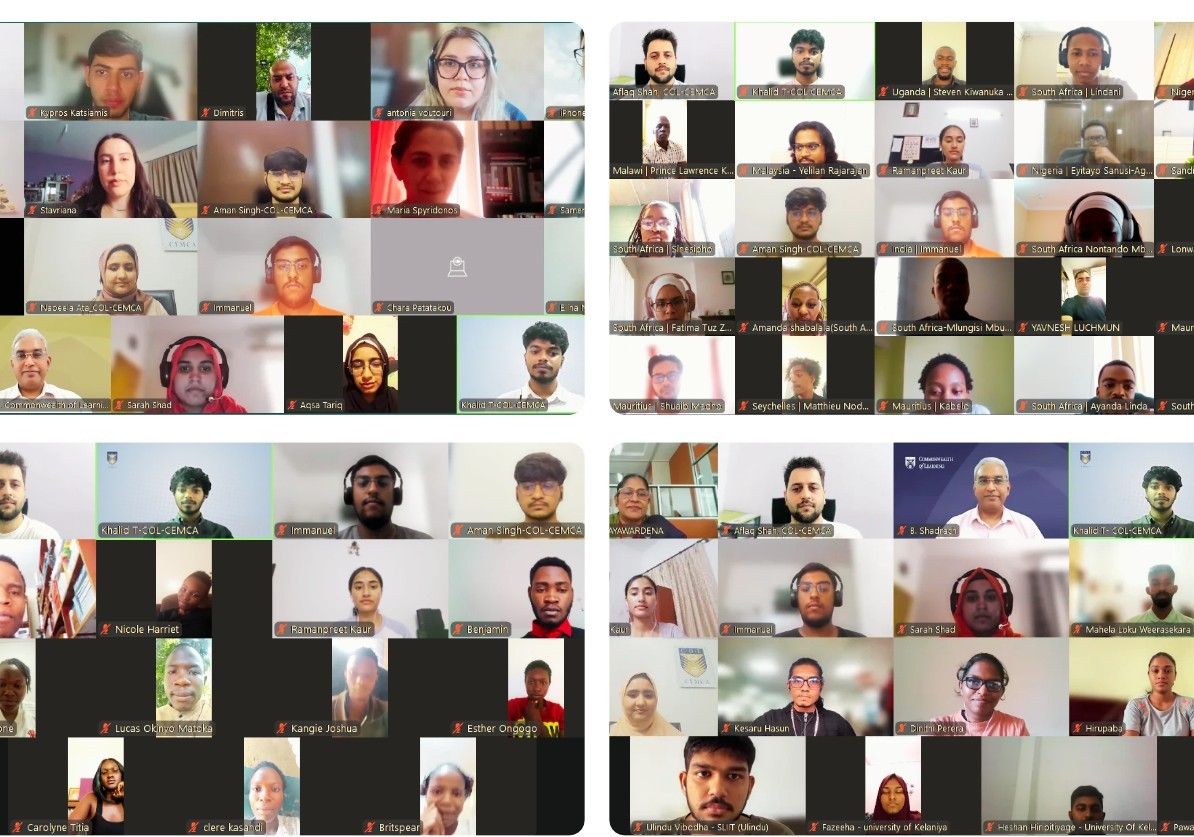
students and youth leaders of the Commonwealth Student Community for AI Governance, from 35 Member Nations, endorsed their student-led communiqué to Heads of Government
ResultCommonwealth Student Community for AI Governance (2026)
Protecting and empowering learners
Harms are already here
Studies suggest that between 16% and 58% of women have experienced technology-facilitated violence.* The rapid rise of AI, including deepfake abuse, is adding new forms of harm.
* Source: UN Women (2025).
Opportunity for action
Members can accelerate in partnership
Build learner protection, accountable human oversight and controls over agent actions into the use of new technologies, such as AI, in education, and listen to young people.
The argument
Protecting learners is a public responsibility. Social media and other digital platforms can expose young people to bullying, harassment and misinformation, and AI services can give inaccurate advice, reproduce discrimination, expose personal information and generate harmful content, including material used to harass, exploit and deceive. These risks bear on child protection, mental health, equal opportunity and public trust, and they fall hardest on women, girls and young people. There is a quieter risk to learning itself. The UN cautions that AI can create an “illusion of competence”, as short-term task performance rises while durable learning weakens (Independent International Scientific Panel on AI, 2026).
Safeguards therefore belong in education policy, public procurement and institutional accountability, and the UK’s product safety standards for generative AI in education show what this can look like in practice (UK Department for Education, 2026). Local control helps: institutions can define permitted uses, draw on approved resources, limit data collection and transfer, and restrict access to sensitive records. Local hosting alone does not make a system safe. AI agents that use tools or change records can disclose information or act before a teacher reviews the output, so controls must limit agent authority as well as protect content (Australian Signals Directorate, 2026). Safeguards need testing in local languages and settings, trained staff, security updates, transparency, and accessible ways to report harm and obtain human review and remedy.
Protection alone is not enough. Young people also need teaching and support to understand and manage these risks.
Proof points
Each card represents evidence in a strategic talking point, chosen because it shows the need or a result of COL’s work. Use the share button to copy a card as an image with a link back to this page.
students and youth leaders of the Commonwealth Student Community for AI Governance, from 35 Member Nations, endorsed their student-led communiqué to Heads of Government
ResultCommonwealth Student Community for AI Governance (2026)
of Teacher-in-the-Loop AI training formally recognised towards India’s mandatory 50-hour annual professional development requirement
ResultCOL (2026)
secondary mathematics teachers in India act as validators and quality filters of AI-generated resources
ResultCOL (2026)
Case study
Students and teachers must set the agenda. Through the Commonwealth Student Community for AI Governance, cohorts in more than 20 countries have called for student-led guidelines on academic integrity, audit trails and disclosure, a shift from bans to accountable use, alongside transparency, privacy and a right to explanation for automated decisions.
Voice of the Youth in Global AI Governance Update · October 2026
In October 2026 the Commonwealth Student Community for AI Governance set out its calls in a Communiqué on Artificial Intelligence Governance and Existential Risk, addressed to the Commonwealth Heads of Government Meeting in St John’s and endorsed by more than 500 of its youth and student leaders from 35 Member Nations. In the video, students from across the Commonwealth present it in their own voices.
Several of their calls echo this talking point: accountable use of AI in place of blanket bans, with audit trails and clear rules on disclosure; a right to explanation, human review and appeal for anyone affected by automated decisions in admissions or grading; and a permanent youth seat on national AI councils. They add that no student should be penalised solely on the basis of an automated detection score, and ask Heads of Government to direct the Commonwealth Secretariat, alongside COL, to establish a permanent Commonwealth Youth AI & ASI Governance Working Group to review progress at CHOGM 2028.
The communiqué expresses the students’ views.
The communiqué’s six areas
Source: Commonwealth Student Community for AI Governance (2026), Communiqué on Artificial Intelligence Governance and Existential Risk, and its video; endorsements counted as the distinct names in its list (pp. 8–31).
Their Global Virtual Conclave is working in four tracks: labour-market transitions and the future of work; local language preservation; transparency, sovereignty and privacy; and the energy and water footprint of computing infrastructure. Supporting learners through empowering teachers, COL’s Teacher-in-the-Loop AI (TiL-AI) builds human oversight into learning design. It is teachers, not software, that must set the task, can intervene at any point and approve what learners receive. They co-create resources with AI agents, then validate them with peers and mentors, and a record of provenance shows what has been checked. The resulting open resources are shared in a public repository for other teachers to reuse and adapt: more than 1,500 peer-reviewed resources have already been published.
In India, 180 secondary mathematics teachers working with the national examination boards CBSE and CISCE now act as co-designers, validators and quality filters of AI-generated learning resources. Forty hours of TiL-AI training are formally recognised towards the mandatory 50-hour annual professional development requirement, making safe, critical use of AI part of teachers’ professional standing (COL, 2026).
The same principle runs through the reference architecture of the Gaborone to New Delhi Compact: three tiers of teacher oversight matched to risk, with logging and controlled access. Its next revision should also set out what an AI agent may do: each agent needs a named owner and access limited to an approved task, consequential actions need human approval before they run, and security teams must be able to suspend and restore services.
COL’s Teacher-in-the-Loop AI (TiL-AI), in the talking point’s words; the order of steps is illustrative. Select a step, or a role that teachers in India now play (2026).
Sources: the talking point (steps, 1,500+); COL (2026) (India roles); step detail from Balaji, Ogange and Mays (2025), Teacher in the Loop AI (TiL-AI), Journal of Learning for Development.
Teachers are shaping the rules: in the Eastern Caribbean (Antigua and Barbuda, Dominica, Saint Lucia, St Kitts and Nevis, and St Vincent and the Grenadines) and in Rwanda, in line with frameworks of the Inter-University Council for East Africa, based in Uganda.
COL partners’ pilots offer settings to test these safeguards with educators, learners and parents. A proposed, time-limited Pan-Commonwealth Learning-focused working group of senior officials and independent experts, linked to existing Commonwealth AI initiatives, may advance the architecture through shared testing methods, procurement requirements and staff training, with small states helping to shape its work.
Safeguards to require
Places of impact
9 of the 56 Member Nations. Every member is one equal tile, so small states stay visible; select a tile to read what happens there.
Opportunity for action
Members can accelerate in partnership
Milestones
Consider Commonwealth Youth Forum outcomes on AI and the GPAI-supported AI Youth Conclave on learner safety and cybersecurity, and support a time-limited expert working group, in harmony with the Commonwealth Secretariat group.
Draft requirements for age-appropriate use, transparency, data protection and agent permissions, and test them in local languages with educators, learners, parents and security teams.
Data and local languagesTrain teachers and security teams, test containment and recovery, open routes to report harm and seek redress, and showcase AI, digital safety and wellbeing literacy in curriculum and teacher development as a model of implementation.
Teacher developmentDemonstrate how your country has locked in the formal voice of young people in national AI and education governance.
We continue to act
COL will work with partners on shared safeguards, testing methods and staff training, and support youth participation in AI governance.
From the newsroom
Stories from the Commonwealth of Learning that highlight this strategic talking point. Each opens on col.org.
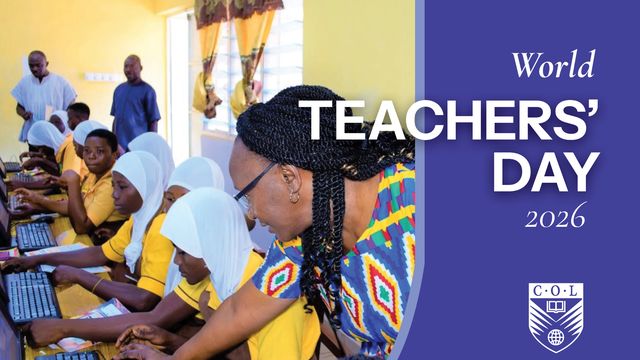
COL supports teachers through AI for Teacher Education, Teacher-in-the-Loop AI, STEAM virtual labs with AFTRA and other partners, and micro-credentials guided by its Commonwealth Micro-credential Framework for Lifelong Learning.
“Micro-credentials offer one way to do this, providing more flexible and transparent pathways for lifelong learning.”
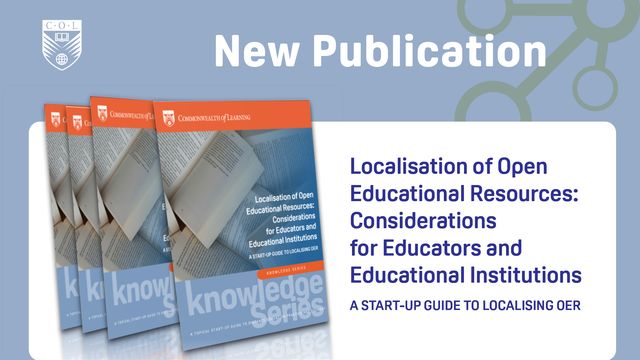
COL has published a Knowledge Series guide on localising open educational resources that highlights Indigenous knowledge and community languages, and cautions that AI-supported localisation needs ongoing human oversight.
“The guide also notes AI’s potential to support localisation, while cautioning that certain languages and knowledge systems are poorly represented in training data.”
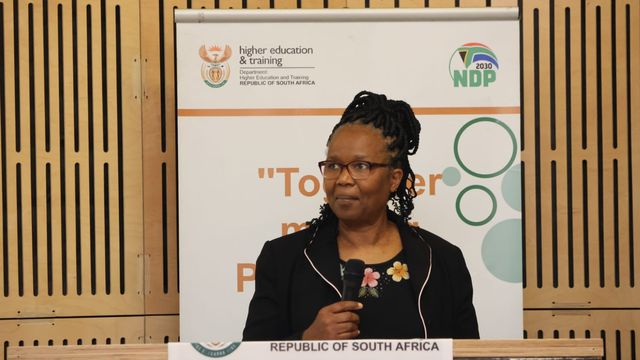
At a national workshop on AI in teacher education convened by South Africa’s DHET with COL, participants developed a principle-based national policy and established a national task team to support implementation.
“MRTEQ is currently silent on AI and must mainstream AI literacy so that it becomes a core attribute of teacher education graduates.”
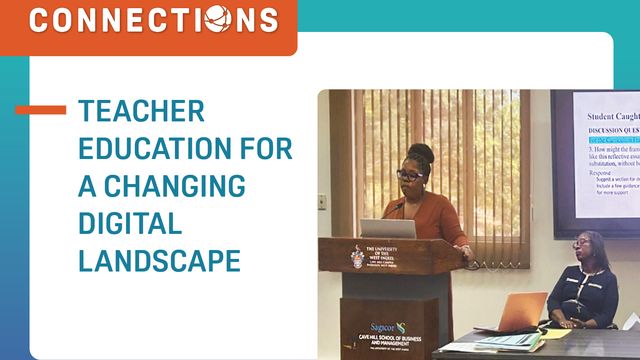
COL is supporting The University of the West Indies, Cave Hill Campus, to co-develop regional AI guidance for teacher education with representatives from five Eastern Caribbean countries; an AI course for teachers will follow.
“developing three public goods: an AI curriculum framework, an AI policy, and an AI code of conduct”
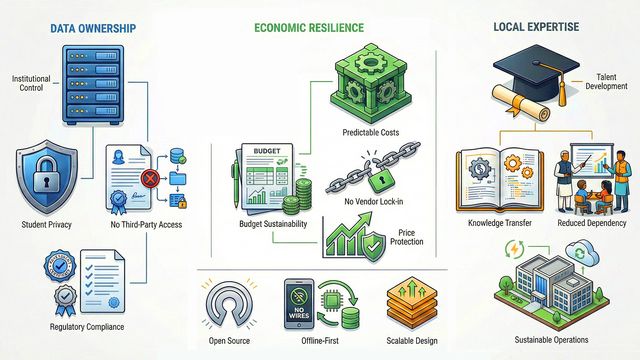
COL’s Frugal AI reference architecture uses open-weights models where appropriate; properly designed, locally hosted AI can help institutions keep learner records within national or institutionally controlled systems, and COL’s AI-agent trials follow a Teacher-in-the-Loop approach.
“Institutions and agencies in Mauritius, Malaysia, Samoa and Vanuatu have formally engaged with COL’s Frugal AI work, and capacity building is under way with the Higher Education Commission of Mauritius.”
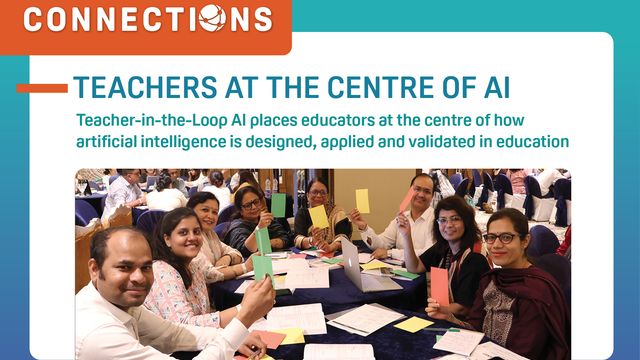
COL’s TiL-AI project in India saw 180 secondary mathematics teachers improve Generative AI use and act as co-designers, validators and quality filters of AI-generated resources, reinforcing that AI should augment, not replace, teacher expertise.
“Forty hours of TiL-AI training have been formally recognised toward the mandatory 50-hour annual teacher professional development requirement in India.”
Working in synergy
This talking point aligns with the Commonwealth Secretariat’s Democratic pillar and the Commonwealth Foundation’s focus on freedom of expression.
Talking points on the same pillar
As printed in the talking point, followed by the further sources used for this site’s charts, diagrams and update.
Further sources for the charts, diagrams and update