of young Pacific women are not in education, employment or training
NeedCOL (2026)
Agility matched with urgent need
Small is powerful
Thirty-three of the world’s 42 small states are Commonwealth Member Nations, many of them island nations.* What works for them can work for the whole Commonwealth.
* Source: Commonwealth Secretariat (2026).
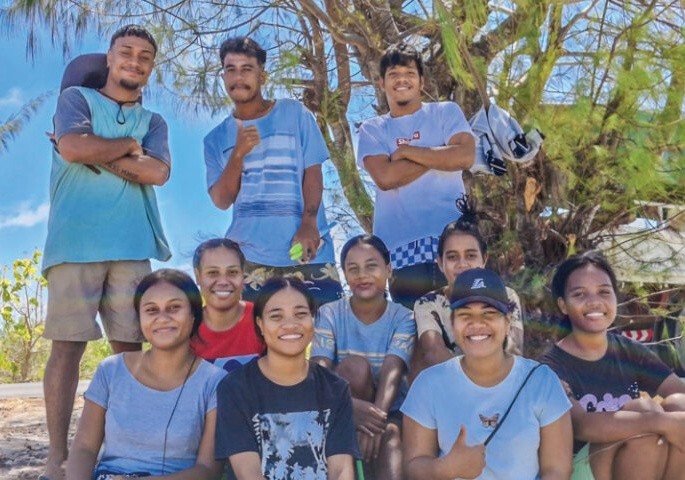
COL continues to act
We support small states as a Commonwealth network to strengthen national institutions and build, test and share learning models, and build long-term partnerships to close the digital gap.
The argument
Small states sit at the sharp edge of the world’s education future: geographic dispersion, thin institutional capacity, climate shocks, youth out-migration, skills shortages and digital divides, alongside rising pressure to prepare learners for AI, green economies and flexible labour markets.
Yet small states also have an advantage. They can move quickly, collaborate closely and test models that larger systems struggle to coordinate. Positioned as beneficiaries, they will keep receiving solutions designed elsewhere. Organised as a network, they can create, adapt and lead as frontline incubators for frugal, resilient and inclusive education.
The time is right. The Antigua and Barbuda Agenda for SIDS, agreed in 2024, set a ten-year course for resilience (United Nations, 2024), and CHOGM now meets in St John’s with small states at its heart.
In the Pacific, for example, open, distance and flexible learning (ODFL) is how systems can reach young people through community learning hubs, mobile and offline content, teachers developed at a distance, and qualifications recognised across the region.
Pacific institutions must own and lead it, with partners investing for the long term.
Proof points
Each card represents evidence in a strategic talking point, chosen because it shows the need or a result of COL’s work. Use the share button to copy a card as an image with a link back to this page.
of young Pacific women are not in education, employment or training
NeedCOL (2026)
of people in Oceania, excluding Australia and New Zealand, used the internet in 2025
NeedUN DESA (2026)
Pacific young people who were outside education, employment and training completed community-based skills training
ResultCOL
per trainee for community-based skills training of young people in the Pacific
ResultCOL
Case study
The Pacific shows what long-term partnership can achieve, and why it matters. Only 26% of people in Oceania, excluding Australia and New Zealand, used the internet in 2025, the lowest share of any region (UN DESA, 2026). About a third of young Pacific women and a quarter of young men are not in education, employment or training, rural young women most affected (COL, 2026).
With support from New Zealand’s Ministry of Foreign Affairs and Trade, COL and Pacific partners completed the first phase of the Pacific Partnership for Open, Distance and Flexible Learning (2020–2025). More than 7,200 educators enrolled in professional development, and some 5,900 young people who were outside education, employment and training completed community-based skills training: a 63% completion rate, with women making up almost two-thirds of participants, at about NZD 81 per trainee. Partners adapted more than 300 open educational resources to local curricula, and after Vanuatu’s 2024 earthquake the learning platform was back within a week.
Results reached across the region. In South Tarawa, Kiribati, more than 240 young people completed skills courses; the Coalition for Education Solomon Islands trained 145 young people, including 93 women and 39 with disabilities; and in Naoero, 33 teachers were trained in learner support for open and distance learning, alongside a national OER collection site and an online TVET toolkit.
The first phase also taught a hard lesson: too few projects found a permanent place in national systems, budgets or qualifications frameworks.
The next phase is a ten-year partnership with New Zealand’s Ministry of Foreign Affairs and Trade, delivered with the Pacific Centre for Flexible and Open Learning for Development (PACFOLD) at the University of the South Pacific, across Fiji, Kiribati, the Marshall Islands, Naoero, Papua New Guinea, Samoa, Solomon Islands, Tonga, Tuvalu and Vanuatu. It will move proven approaches into national systems, budgets and qualifications frameworks, so that by 2036 Pacific institutions own, finance and deliver them, with COL in support.
The sequence is deliberate: “Ownership comes before scale, and evidence comes before expansion” (COL, 2026). Five design gates, covering safeguarding, recognition pathways, institutional ownership, climate content and evidence readiness, must be passed before delivery scales in any country.
The work has three strands: pathways for young people outside education and work, through community learning hubs, foundation programmes, recognition of prior learning and mentoring; recognised credentials for teachers in open and distance learning, STEM and climate-responsive teaching; and stackable micro-credentials in green skills such as solar installation and climate-resilient construction. At least half of all participants will be women, and at least 65% in the youth stream.
The five design gates of the 2026–2036 partnership: all must be passed before delivery scales in any country. Pass each gate to see what the talking point and COL (2026) say about it; the diagram shows the rule, not any country’s progress.
Sources: the talking point; lines marked ‘related’ are from COL (2026), A ten-year partnership for flexible learning across ten Pacific Island countries.
Pacific young people bring creative and digital talent too, from YUT PAWA’s young entrepreneurs in Vanuatu (TP09) to digital skills that turn connection into livelihoods (TP06): pathways that the partnership’s community hubs and micro-credentials can recognise and grow.
Different business models
| Small states | Large states |
|---|---|
| Shared regional curriculum, platforms and specialist expertise | Distributed national or subnational delivery networks |
| Common assessment and quality assurance where feasible | National standards with locally adapted implementation |
| Regional cohorts make specialised programmes viable | Scale lowers unit costs but adds coordination complexity |
| National recognition with pooled technical infrastructure | Interoperable data, credential and learner support systems |
In Antigua and Barbuda work spans policy, teachers, tertiary education, TVET and livelihoods, and Antigua State College connects through COL’s Virtual University for Small States of the Commonwealth (VUSSC) to a network of 33 small states. Grenada’s digital transformation of TVET is becoming a model for other small states, and in Dominica, Kalinago farmers are learning climate-smart practice in a Farmer Field School (TP07). Malta, where COL’s partnership since 2017 led to the Commonwealth Centre for Connected Learning (3CL; Grech, 2025), has national blockchain-based credentials, which were showcased at COL’s Caribbean Focal Points Meeting in March 2026.
Places of impact
14 of the 56 Member Nations. Every member is one equal tile, so small states stay visible; select a tile to read what happens there.
COL continues to act
We support small states as a Commonwealth network to strengthen national institutions and build, test and share learning models, and build long-term partnerships to close the digital gap.
From the newsroom
Stories from the Commonwealth of Learning that highlight this strategic talking point. Each opens on col.org.
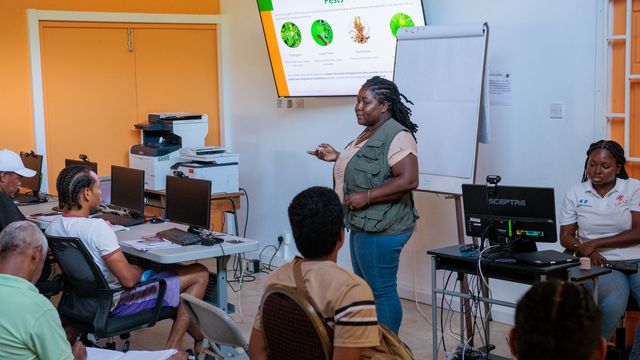
COL helps small states build resilience through skills for the green, blue and orange economies: a Farmer Field School in Dominica, four blue economy MOOCs with the University of Seychelles, and micro-credentials with The University of the West Indies, Mona, that help educators engage learners through creative expression.
“More than 6,000 learners from over 70 countries enrolled in these courses”
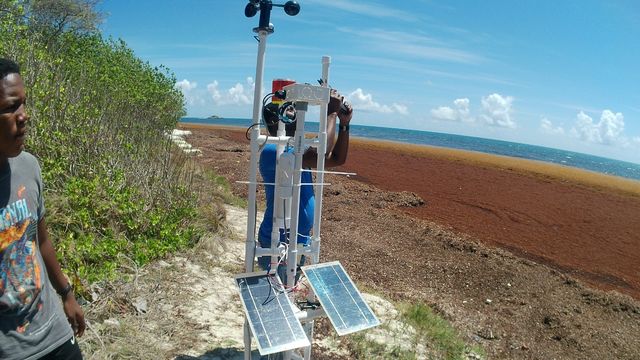
COL’s Youth Robotics for Blue-Green Resilience and Prosperity pilot has seven Caribbean youth robotics teams and a research, media and advocacy team, with selected participants to present at CHOGM in Antigua and Barbuda.
“The Robotics Design and Prototype stream consists of 49 young people aged 16 to 23 who will develop potential responses to challenges”
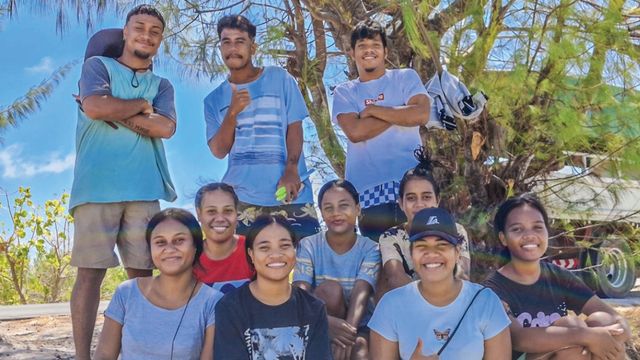
With New Zealand MFAT support, COL is launching Phase 2 of the Pacific Partnership for Open, Distance and Flexible Learning, a decade-long effort running 2026–2036 across ten Pacific Island countries.
“More than 7,200 educators enrolled in professional development to drive up the quality of open education.”
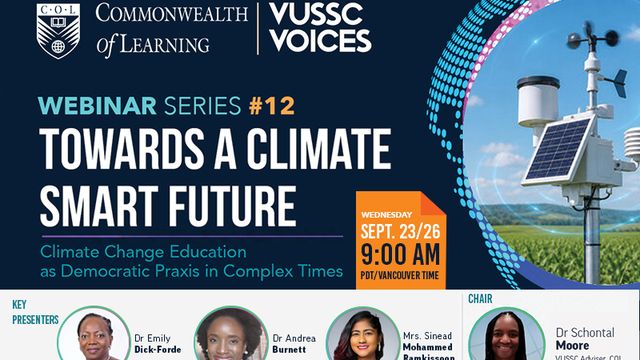
Chaired by COL’s VUSSC Adviser Dr Schontal Moore, the online session scheduled for 23 September 2026 was to include a University of the West Indies Global Campus presentation on climate change education as democratic praxis.
“VUSSC Voices, a webinar series highlighting expert voices from COL’s Virtual University for Small States of the Commonwealth (VUSSC) network, returns with its 12th webinar on climate-smart futures.”
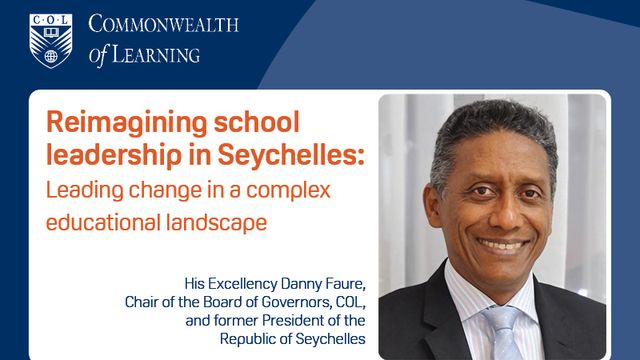
In a keynote to Seychelles headteachers, COL Board Chair Danny Faure proposed open schooling to reach young people not well served, including NEETs, and highlighted COL-supported teacher digital professional development.
“A cascading capacity-building model trained 71 Master Trainers, who subsequently trained 554 teachers nationwide from 37 schools.”
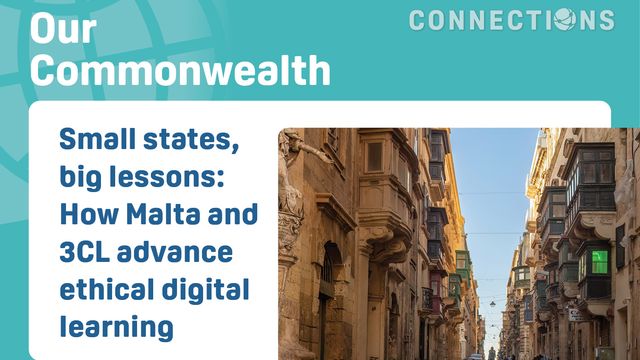
Malta, one of 33 Commonwealth small states, hosts the Commonwealth Centre for Connected Learning (3CL), and initiatives launched there, such as a nation-state blockchain system for verifiable credentials, have often scaled beyond its shores.
“Such initiatives reflect 3CL’s belief that small states are not peripheral actors, but pivotal contributors to global EdTech and open learning ecosystems.”
Working in synergy
This talking point aligns with the Commonwealth Secretariat’s Economic and Climate pillars and the Commonwealth Foundation’s focus on economic inclusion and climate and environment justice.
Connections named in the talking point
Talking points on the same pillars
As printed in the talking point, followed by the further sources used for this site’s charts and diagrams.
Further sources for the charts and diagrams