

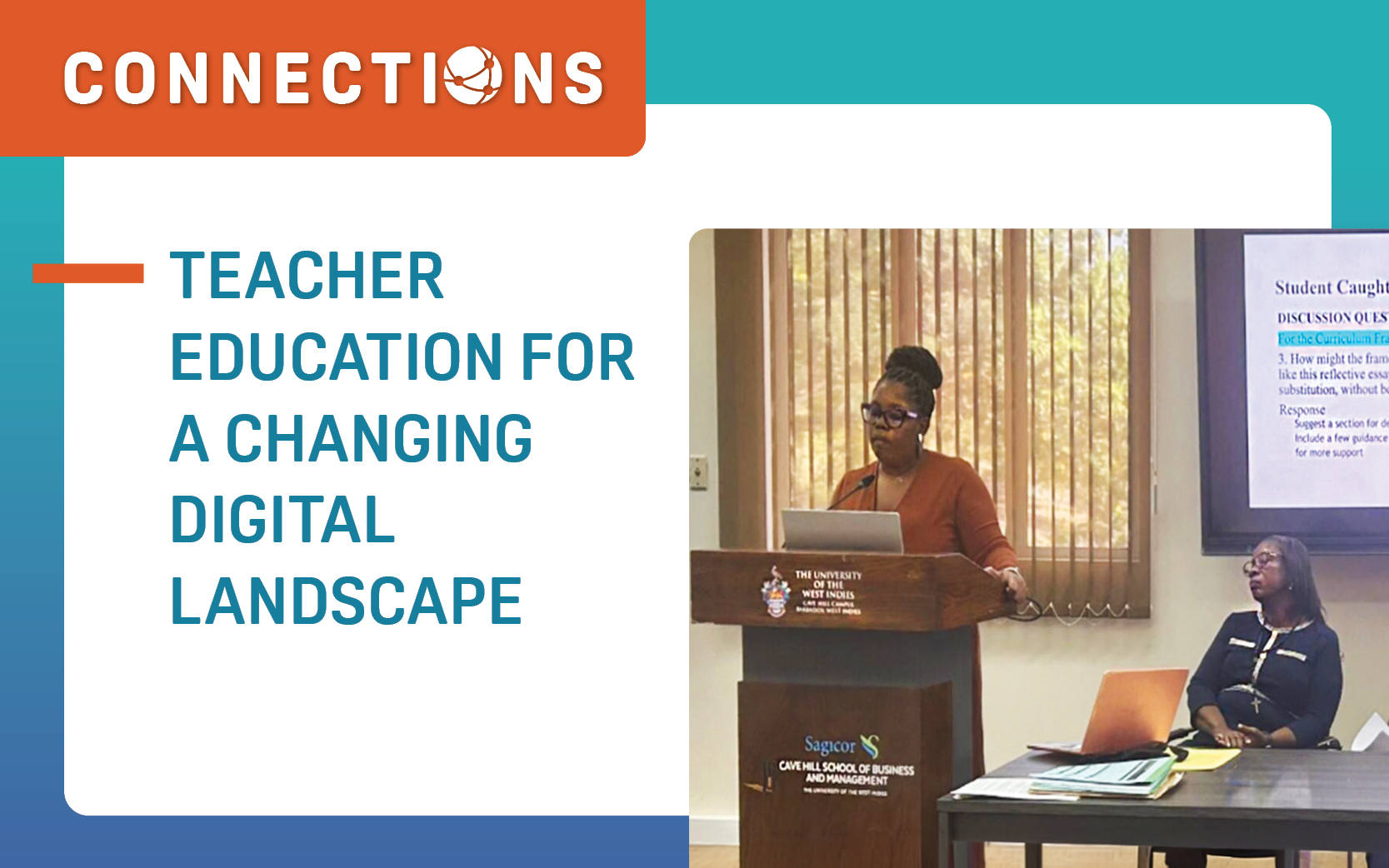
In the Eastern Caribbean, the conversation about artificial intelligence in teacher education is shifting beyond novelty towards structured governance and accountability. The question is no longer whether AI should be used, but how its application can be guided and aligned with the public good.
This speaks to the significance of COL’s support for The University of the West Indies, Cave Hill Campus, in Barbados, through the Eastern Caribbean Joint Board of Teacher Education, in developing three public goods: an AI curriculum framework, an AI policy, and an AI code of conduct. Signed in November 2025, the agreement is intended to enable institutions across the region to adopt and apply AI responsibly and consistently, providing a shared foundation for implementation.
Dr Laurette Bristol, Director of the School of Education and Chair of the Eastern Caribbean Joint Board of Teacher Education, notes that the initiative addresses “one of the most marginalised groups of educators, that is, teacher educators” and urges participants to view teacher education as a system, a practice, and a culture to be reshaped through the ethical and responsible use of AI to strengthen teaching quality and improve learning outcomes. Her emphasis on a participatory, co-constructive process highlights a key principle: policies are more likely to endure when the institutions responsible for implementation actively contribute to shaping them.
ETHICAL INTEGRATION OF AI
That principle is reflected in the project structure. Ten regional representatives from teacher education institutions and ministries of education in Antigua and Barbuda, Dominica, Saint Lucia, St Kitts and Nevis, and St Vincent and the Grenadines participated in a one-day online preparatory session in January 2026, followed by a five-day regional workshop in February 2026 focused on developing the three documents. In April 2026, the draft framework, policy, and code of conduct will undergo review through an online validation workshop involving at least 40 regional participants.
The intended outcome is regional guidance, developed by educators for educators, on the ethical integration of AI in Caribbean teacher education systems, which will support more consistent and informed practice across institutions.
STRENGTHENING EDUCATION SYSTEMS
But the deeper value of this work lies in building professional readiness and capability. Teachers and teachers-in-training need more than access to AI tools; they require the capacity to judge when AI supports learning, when it undermines it, and how to use it critically, ethically, and transparently. Similar COL-supported work with teacher education institutions in Africa, including initiatives in Ghana and East Africa, demonstrates that this forms part of a broader effort to position educators at the centre of AI adoption. In this sense, the initiative is not simply about technology uptake; it is about strengthening teacher education systems to enable educators to exercise informed professional judgement in a rapidly evolving knowledge environment, in line with COL’s mission of learning for sustainable development.
Building on this foundation, COL and participating countries will develop an AI training course for teachers to strengthen further capacity for the effective and ethical use of AI in teaching and learning.
This story was originally published in the April 2026 issue of Connections. Read the full issue: https://hdl.handle.net/11599/6130.