

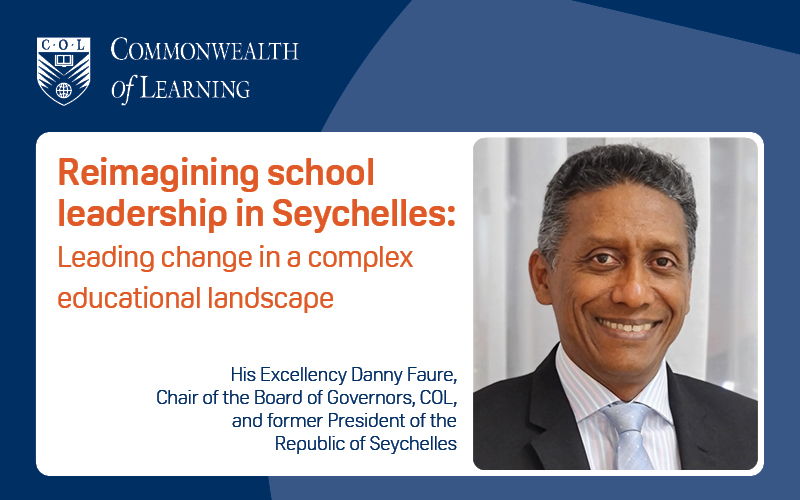
Delivering the keynote address at the University of Seychelles’ recent Headteachers’ Retreat, held under the theme Reimagining School Leadership in Seychelles Today, His Excellency Danny Faure, Chair of the Commonwealth of Learning Board of Governors and former President of the Republic of Seychelles, reflected on what it means to make education relevant in a rapidly changing world. He highlights that relevance is not about lowering standards, but about equipping learners to think critically, solve problems, use technology responsibly and make informed decisions about their futures. Read the full text of his keynote address below.
Distinguished headteachers, colleagues and friends,
It is a pleasure to join you for this retreat on reimagining school leadership in Seychelles.
The theme is timely. Around the world, education systems are being asked to respond to rapid social, economic and technological change. Schools are no longer expected only to deliver the curriculum as it has always been delivered. They are expected to prepare young people for uncertain futures, shifting labour markets, digital societies, environmental pressures and changing expectations from families, communities and governments.
Seychelles faces this complexity in a very particular way. It is a small island state with strong national ambitions, a high-income economy, a vibrant tourism sector and growing investment in digital transformation. At the same time, there are young people who are at risk of being left behind, including those not in employment, education or training, currently estimated at about 20% of those aged 15-24. There are also continuing questions about how education can become more responsive to learners’ futures, including vocational pathways, life skills, digital skills and new forms of lifelong learning.
This is why school leadership matters so much. Headteachers are not simply administrators of schools. You are leaders of learning, leaders of people, and leaders of change. The transformation of education in Seychelles will not happen only through policies, infrastructure or technology. It will happen through the leadership choices made in schools, the professional cultures built among teachers, and the opportunities created for learners.
I would like to suggest three leadership imperatives for this moment:
- Leading for relevance
- Leading for digital transformation
- Leading professional cultures.
Leading for relevance: ensuring learning connects with young people’s futures, including employability, vocational pathways and life skills
This point is central. If education is to remain meaningful, it must connect with the lives and futures of young people. Relevance does not mean lowering standards. It means ensuring that what students learn helps them to think, solve problems, work with others, use technology responsibly, communicate well and make informed choices about their futures.
For some learners, the pathway will be academic and lead to tertiary education. For others, the pathway may be vocational, technical, entrepreneurial or linked to service sectors such as tourism, the blue economy, the creative economy, digital services or community development. A future-ready education system must recognise all these pathways as valuable.
This is where open schooling can be part of the wider solution. Open schooling can augment the traditional system by providing more flexible, responsive and learner-centred pathways. It can support learners who need a second chance, those who require more flexible pacing, and those who benefit from practical, skills-oriented learning opportunities. It can also help schools respond to learners who may be disengaged from conventional schooling but still have potential, talent and ambition. Twenty-three other countries in the Commonwealth are already augmenting in-person schooling in this way in order to reach that additional 20% of young people not currently well-served and also to create an integrated schooling system more resilient to disruption by pandemics, extreme weather or other emergencies.
Reimagining school leadership therefore means asking hard questions: Are our schools helping learners see a future for themselves? Are we connecting learning with real-life opportunities? Are we equipping young people with the skills, confidence and values they need to participate meaningfully in society and the economy?
Leading teacher education for digital transformation, not just technology adoption
The second leadership imperative is teacher education. Digital transformation in education cannot be reduced to placing devices in classrooms or installing smart technologies. These are important, but they are not sufficient.
The Seychelles Smart Education Project recognises the need for teacher education related to digital transformation clearly. It aims to equip schools with smart classroom solutions, digital tools, cloud-based learning management systems and video conferencing capacity, while strengthening teachers’ ability to use these technologies effectively in teaching and learning. The project also links digital literacy to workforce readiness and Seychelles’ broader digital economy agenda.
Alongside this, the evolving National Artificial Intelligence in Education Framework provides an important policy direction for the safe, ethical and purposeful use of AI in education. Taken together, these initiatives represent a significant national investment in future-ready schools, digitally confident teachers and more responsive learning environments.
However, the key question for school leaders is not only whether technology is available. The deeper question is whether teachers are confident, supported and professionally prepared to use technology to improve learning.
This is where the recent National Workshop on Teacher Digital Competencies is important. Delivered by the Ministry of Education and Human Resource Development in partnership with the Commonwealth of Learning, the workshop brought together 30 participants from across the education sector, including curriculum specialists, educational technology officers, professional development facilitators, teacher educators, school leaders and secondary school teachers.
The workshop focused on digital pedagogies, Open Educational Resources, Artificial Intelligence, lesson planning, assessment, resource creation and responsible use of technology. It was not only about tools. It was about teaching practice. It was about helping teachers understand how digital resources, OER and AI can support better planning, more engaging lessons, inclusive learning and more effective assessment.
This matters because teachers remain central to transformation. One powerful message from the Minister’s opening remarks at the workshop captures this well:
“Technology is not the transformation. You are. Digital tools are precisely that, the tools. It is the teacher who breathes life into them.”
That message should guide school leadership. The role of the headteacher is to create the conditions in which teachers can learn, experiment, collaborate, reflect and improve. Teachers need space to build confidence. They need professional development that is practical and sustained. They need guidance on ethical and responsible AI use. They need support to adapt OER and digital resources to local classroom realities.
The Commonwealth of Learning, in partnership with the Teachers Council of Seychelles, has demonstrated how open and distance learning can strengthen national teacher professional development systems. Between 2024 and 2026, the initiative progressed from establishing a national ODL framework to implementing a digital learning ecosystem that expanded access to continuous professional development for teachers across Seychelles. The initiative also contributed to the development of a regional framework under the Africa Federation of Teaching Regulatory Authorities (AFTRA).
COL supported the establishment of a Moodle Cloud Learning Management System and the development of seven contextualised digital literacy courses adapted from COL Commons resources. A cascading capacity-building model trained 71 Master Trainers, who subsequently trained 554 teachers nationwide from 37 schools. By the end of the implementation period, 161 teachers had successfully completed the programme and received certificates, demonstrating the effectiveness of the national professional development model.
The implementation was characterised by strong institutional leadership and rapid execution. Schools assumed responsibility for training their own staff while the Teachers Council provided national coordination, quality assurance, and strategic oversight. The Learning Management System ultimately reached full platform capacity, indicating strong demand for structured digital professional development among educators.
The experience generated several important lessons. Establishing a national policy framework before implementation created a strong foundation for scaling digital professional development. Building institutional ownership through school-based Master Trainers proved essential for sustainability, reducing dependence on external facilitators while strengthening local expertise. The initiative also demonstrated that successful digital transformation depends as much on people as on technology. Continuous support, mentoring, and leadership encouraged teachers to participate and complete the training. Adapting learning materials to the local context increased relevance and engagement, while beginning implementation before every component was perfected helped build momentum and accelerate national adoption. Finally, reaching full platform capacity confirmed that teachers are ready to engage in online professional learning when it is accessible, relevant, and well supported.
The Seychelles experience provides a practical model for other countries seeking to strengthen teacher professional development through open and distance learning. Future efforts should build on this foundation by expanding participation, improving completion rates, strengthening institutional support, embedding digital continuous professional development within national teacher development systems, and sharing the lessons through regional collaboration under AFTRA. The initiative demonstrates that sustainable digital transformation is achieved through strong policy, institutional ownership, capacity building, and ongoing support for educators.
For school leaders, then, the challenge is therefore to move beyond asking, “Do we have the technology?” and instead ask, “How are we helping teachers use technology well?”
Leading professional cultures that sustain teacher learning and school-based innovation
The third leadership imperative is to build professional cultures that sustain change. One-off workshops can create momentum, but real transformation happens when learning continues inside schools.
This is why the School-Based Mentoring Programme on Teacher Digital Competencies, OER and AI Integration is so important. The programme was launched as the next phase of the national workshop and is being piloted in four secondary schools: Beau Vallon, Anse Royale, Anse Boileau and English River.
The mentoring programme is designed to help teachers translate workshop learning into classroom practice. It includes school mentoring teams, classroom support, reflective practice, resource development, evidence collection and reporting. This is exactly the kind of approach that can turn policy ambition into practical change.
It also aligns well with the Professional Competency Framework for Teachers in Seychelles. The framework emphasises professional learning, mentoring, ICT and digital literacy, collaboration, assessment, inclusion and school improvement. It recognises that teachers develop across different career stages and that experienced teachers have a responsibility to support the growth of others.
For headteachers, this means that leadership is not only about supervising teachers. It is about developing teachers. It is about building a school culture where teachers learn from one another, where mentoring is valued, where innovation is encouraged, and where evidence from classrooms informs school improvement.
In a complex educational landscape, headteachers must be the bridge between national policy and classroom practice. You are the people who help teachers interpret change, manage uncertainty and remain focused on learners. You are also the people who can ensure that digital transformation does not become an additional burden, but a meaningful opportunity to improve teaching and learning.
This requires courageous and thoughtful leadership. It requires leaders who can protect time for professional learning, encourage peer support, support responsible experimentation, and ensure that innovation remains inclusive. It also requires leaders who understand that change is not always immediate. Teachers may begin with different levels of confidence and digital competence. Some will move quickly. Others will need more guidance. The task of leadership is to bring the whole school forward.
As Seychelles advances its SMART Education agenda, the leadership of headteachers will be decisive. Smart classrooms, digital tools, OER and AI can open new possibilities. But their value will depend on the professional judgement of teachers, the learning culture of schools and the leadership that holds everything together.
Reimagining school leadership in Seychelles is therefore about leading for relevance, leading teacher education for digital transformation, and leading professional cultures that sustain change.
If these three areas are held together, Seychelles can build an education system that is more responsive to young people’s futures, more confident in its use of technology, and more grounded in the professional growth of its teachers.
Here are some questions that you might like to consider during your retreat:
- How more “open” can education be, including Open Schooling and beyond; to reach to Seychelles NEETs including disengaged boys?
- As the world notes concern about Social Media trends, what is the Seychelles voice on disruptive media?
- And coming to the even more challenging role of AI, what are the concerns and opportunities – both for teaching and learning leaders and for the wider community?
- And finally, how can we build and sustain communities of practice to support continuous professional development that impacts positively on schooling achievements?
Thank you.