
How open learning is helping small states strengthen resilience and participate in the blue, green, and orange economies.
For many small states, climate resilience is often discussed in terms of sea walls, disaster preparedness, and climate finance. These investments are important. Yet one of the most significant ingredients of resilience is often overlooked: people with the knowledge and skills to adapt, innovate, and build sustainable livelihoods.
This is where COL has focused its contribution. We are helping Commonwealth countries strengthen technical and vocational education and training (TVET), open learning, and workforce development so people are prepared not only to respond to climate change but also to participate in opportunities emerging from the blue, green, and orange economies.
To help people access opportunities across these emerging economies, COL works with local and regional partners to identify skills gaps, develop relevant courses and occupational standards, strengthen training institutions, and deliver flexible learning to remote and underserved communities. This approach connects practical and indigenous knowledge with recognised qualifications, employment, and entrepreneurship.
The need is clear. During a recent Pacific Open, and Distance and Flexible Learning workshop, representatives from ten Pacific island countries identified common challenges facing small states. They highlighted limited access to climate-relevant skills, insufficient opportunities for young people to enter emerging blue and green sectors, difficulties integrating indigenous knowledge into education, and the need for more affordable learning opportunities for remote communities. Although these discussions took place in the Pacific, they echoed priorities already familiar across other Small Island Developing States in the Caribbean and Africa.
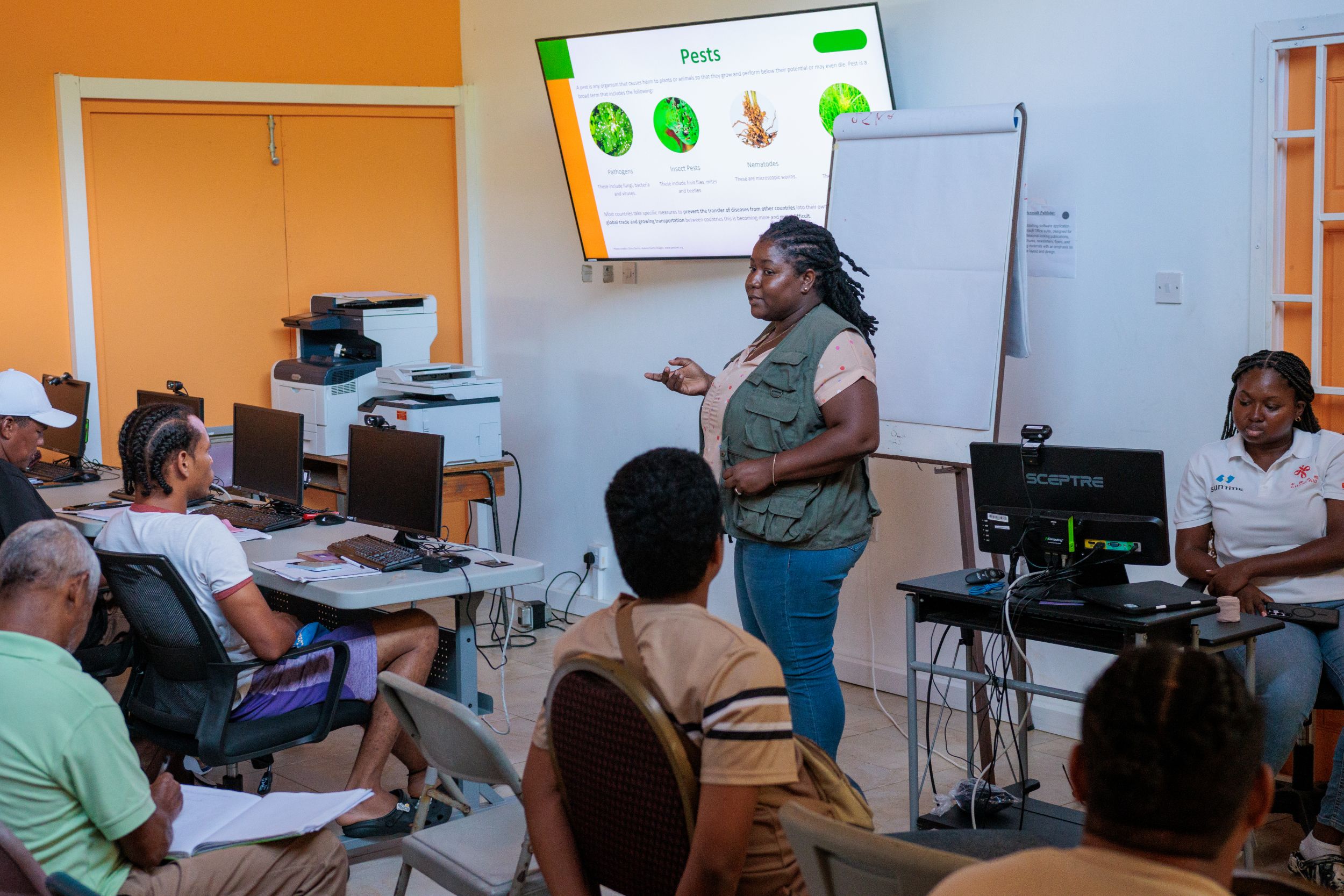
COL’s response has been to help countries build the skills needed for resilience. On land, this can be seen in Dominica, where COL partnered with The University of the West Indies Global Campus to establish a Farmer Field School. Rather than removing farmers from their daily work, learning takes place in the field itself. Farmers test new approaches, exchange experiences, and strengthen their understanding of sustainable agriculture, food security, and digital technologies. Their experiences are recounted in the short documentary film Harvest & Heritage, illustrating how practical learning can strengthen livelihoods while preserving local knowledge and cultural traditions.
At sea, COL has invested in expanding knowledge of the blue economy. In partnership with the University of Seychelles and the James Michel Blue Economy Research Institute, We developed a series of four massive open online courses introducing learners to sustainable ocean management. Participants explored ocean governance, marine resources, blue finance, and the management of coastal spaces. More than 6,000 learners from over 70 countries enrolled in these courses, demonstrating both the global demand for this knowledge and the ability of open learning to reach small states that may lack specialised institutions.
Small states also draw on another valuable resource: their creativity. The orange economy, rooted in culture, the arts, and creative expression, offers opportunities to turn that resource into social and economic value. COL has supported the Department of Literatures in English at The University of the West Indies, Mona, in developing a suite of online micro-credentials that strengthens educators’ capacity to engage learners through literature, writing, poetry, and other forms of creative expression.
By bringing the literary arts more deliberately into teaching and learning, the initiative helps nurture imagination, communication, and creative confidence, capacities that can extend beyond the classroom into writing, performance, media, and other creative industries. For small states, this also means keeping cultural expression alive while developing the creative talent the orange economy depends on.
Learning alone, however, is not enough. Employers must also recognise skills and align them with labour market needs. To address this, COL has supported the review and development of occupational standards across the green, blue, digital, and creative economies. Working with regional partners such as the Caribbean Association of National Training Authorities (CANTA), these standards provide a foundation for competency-based training, assessment, and certification, helping countries prepare workers for emerging occupations while supporting enterprise and economic growth.
We have also encouraged institutions to integrate sustainability into their own operations. Research on zero-waste practices in TVET institutions informed the development of institutional strategies and a micro-course that supports colleges and training providers in embedding sustainable practices into everyday teaching and management. These initiatives recognise that climate resilience is built not only through individual learners but also through stronger institutions.
Taken together, these initiatives illustrate COL’s approach to resilience in small states. It begins by listening to countries and understanding their needs. It continues by developing accessible, relevant learning opportunities. It supports institutions in strengthening their capacity, and it helps translate learning into recognised skills that contribute to employment, entrepreneurship, and sustainable development.
Ultimately, resilience is about people as much as resources. Oceans, forests, and fertile land create opportunities, but so too do the stories, creativity, and cultural knowledge of communities. Skills enable people to use these resources responsibly, productively, and imaginatively. By strengthening TVET, expanding access to open learning, and supporting practical and creative skills development, COL is helping small states build resilience that extends beyond recovery from climate shocks to long-term economic, social, and cultural well-being.
Readers who want to see these ideas in practice are encouraged to watch Harvest and Heritage, which follows participants in Dominica’s Farmer Field School and shows how learning, local knowledge, and community action are helping build more resilient livelihoods. Together with COL’s Blue Economy learning series and its work in creative education, it offers a wider picture of how education is helping small states draw on the resources they possess, on land, at sea, and within their people, to prepare for a changing world.