
By Professor Peter Scott, President and CEO, COL
Building on a successful Commonwealth Pacific Partnership
In a 10×10 investment, New Zealand is working with the Commonwealth of Learning and Pacific Partners to build on the success of flexible learning for skills and youth for the next ten years across ten Pacific Island countries.
With the support of New Zealand’s Ministry of Foreign Affairs and Trade (MFAT), the Commonwealth of Learning (COL) is launching Phase 2 of the Pacific Partnership for Open, Distance and Flexible Learning (PP ODFL), a decade-long effort to strengthen education and skills across the Pacific. The new partnership phase runs from 2026 to 2036 and works with ten Pacific Island countries: Fiji, Kiribati, Marshall Islands, Naoero, Papua New Guinea, Samoa, Solomon Islands, Tonga, Tuvalu and Vanuatu. Building upon Phase 1, we are delighted to extend this work even beyond the Commonwealth to include the Marshall Islands. The Pacific Centre for Flexible and Open Learning for Development (PACFOLD) at the University of the South Pacific is COL’s regional delivery partner.
Building on success
The ten-year partnership plan is defined in two 5-year elements to build upon the success of our just completed five-year programme, that showcased the value of flexible learning for the Pacific. We were very pleased that the evaluation of Phase 1 (2020 to 2025) offered a clear demonstration of the power of digital, open and flexible learning for the Pacific and particularly for small island states. More than 7,200 educators enrolled in professional development to drive up the quality of open education. This quality drive sat alongside highly effective skills delivery, in which some 5,900 young people who were outside education, employment and training completed community-based skills training, with a completion rate of 63 per cent, women making up almost two-thirds of participants, and a cost of about NZD 81 per trainee. This first phase of Pacific Partnership produced more than 300 open educational resources adapted to local curricula and contexts. To give just one small but telling example of resilient, high-quality delivery, when an earthquake struck Vanuatu in 2024, the programme’s cloud-hosted learning platform was back in service within a single week!
Education systems change slowly, and durable change in small island states calls for patience, continuity and trust between partners. The first five years lay the foundation. The second five year element will scale that which the evidence shows is really working, country-by-country.
Phase 1 also highlighted a familiar challenge. Projects and partners achieved strong results, but too few had found a permanent home in national systems, budgets and qualifications frameworks. Phase 2 will close that gap. Its purpose is to mainstream Phase 1 results, moving proven approaches from pilot to routine practice, owned and financed by Pacific institutions. The new work therefore gives as much attention to removing the constraints holding systems back as it gives to delivering courses and training. Ten such constraints were identified from Phase 1 experience and validated with Pacific education leaders, among them the recognition of ODFL credentials within national qualifications frameworks, institutional ownership backed by budget authority, climate-resilient infrastructure, educator and trainer capability, safeguarding, and evidence systems. Five design gates, covering safeguarding, recognition pathways, institutional ownership, climate content and evidence readiness, must be passed before delivery scales in any country. Ownership comes before scale, and evidence comes before expansion.
Co-designed with and by the Pacific
In February 2026, I led a COL team to work with 45 leaders from all 10 programme countries in Nadi, Fiji, for four days of regional consultations, to ensure that the Phase 2 design fully belongs to the region. Working in three technical groups, the team tested the problem analysis against country evidence, ranked the binding constraints country by country, and co-designed nine key intervention packages. Three sub-regional consultations (May-June 2026) and a regional stakeholder survey extended and validated this work.
The consultations identified three core areas:
- First is young people who are not in education, employment or training. Around a third of young Pacific women and a quarter of young men are in this position, and rural young women are affected most. This Phase 2 10×10 programme offers them a new bite at learning through community learning hubs, foundation programmes in literacy, numeracy and digital skills, recognition of prior learning, and mentoring into climate-resilient livelihoods.
- The second is the upgrading of teachers, with an emphasis on STEM. Educators will earn recognised credentials for professional development in ODFL, STEM teaching and climate-responsive pedagogy, aligned to national and regional qualifications frameworks and supported by offline servers, solar-powered hardware and communities of practice.
- And, third is the credentialing of skills training. Working with employers, TVET institutions and qualifications authorities, the programme will develop stackable micro-credentials in green skills such as solar installation, climate-resilient construction and sustainable agriculture, so that skills gained through flexible learning are trusted, portable and recognised.
Inclusion and climate in every action
Two commitments shape every activity and output.
- Gender equality, disability and social inclusion(GEDSI) is a design condition for the whole programme. Dedicated resources build partner capability, a disability screener at learner intake triggers individual support, and participation targets call for at least half of participants to be women across the programme and at least 65 per cent in the youth stream.
- Climate change is treated as both content and operating condition. Learners, teachers, and communities will gain climate literacy, green skills, and disaster preparedness, while delivery systems are built to keep learning going through cyclones, power outages and displacement. Each year, the programme will review all learner facing activities to ensure the quality of its climate content.
What happens next
Initiating a full programme for the next ten years requires us to be very clear about our starting position, so we’ve framed the first year as ‘inception’. For baseline assessments, the Commonwealth team will focus on country plans, partner selection and safeguarding audits for every Pacific Partner. By 2036, Pacific institutions will be empowered to deliver high quality, inclusive and accredited flexible learning through their own staff, programs and governance, with the Commonwealth Partnership team in a supporting role.
To learn more about the Pacific 10×10 flexible learning partnership, contact: PacificPartnership@col.org.
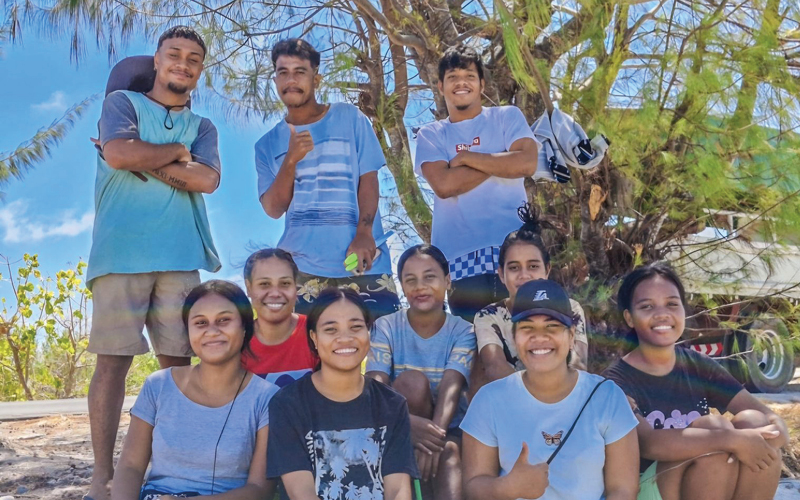
From March to May 2025, more than 240 young people in South Tarawa, Kiribati gained practical skills for work and entrepreneurship through nine inclusive courses delivered by MWYSSA and COL, with support from New Zealand MFAT, Kiribati, 2025. (Image credit: https://www.facebook.com/mwyssaKiribati, Ministry of Women Youth Sport and Social Affairs)