

By Robert Okinda (COL Adviser: Skills), with input from Ricky Cheng (COL Knowledge Services Manager)
Discussions about AI in education often focus on its potential to support educational institutions, teachers, and students. However, its benefits extend far beyond traditional education systems, supporting students in technical and vocational education and training (TVET), and lifelong learners already in the workforce. When designed and governed ethically, such as through COL’s Frugal AI framework, AI in education has the potential to transform skills training by strengthening workforce readiness, personalising upskilling pathways, and improving employability outcomes.
COL champions Frugal AI as a pathway to digital self-reliance, helping to bridge digital divides, strengthen sovereign capacity, and support the responsible scaling of AI adoption in TVET systems. Building on the foundations laid out in our previous feature, “Frugal AI: A Roadmap to Sovereign GenAI for Education,” this post explores practical implementation lessons for applying Frugal AI specifically within skills training and TVET. In practical terms, Frugal AI enables TVET institutions to adopt open-source, offline-capable, and low-cost AI solutions that strengthen skills training, improve administrative productivity, and support course innovation in resource-constrained environments, with appropriate governance and human oversight.
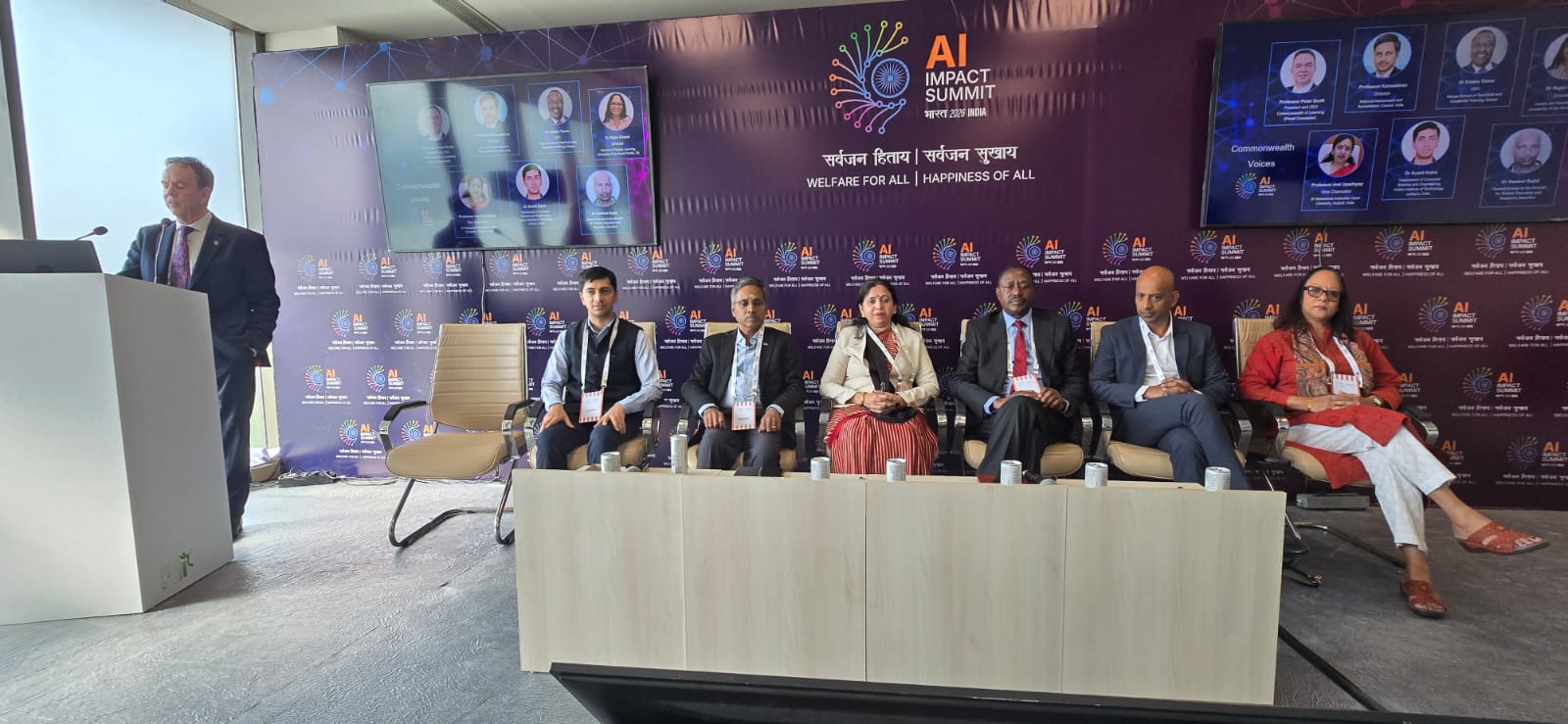
This month, much of the AI community’s attention was focused on the India AI Impact Summit 2026 in New Delhi. COL convened a session on teacher-led, frugal, and inclusive AI to advance more equitable education across the Commonwealth. Leaders from Commonwealth Member Countries were invited to endorse the Gaborone to New Delhi Compact, a framework that helps keep teachers at the centre of AI in education, strengthens local capacity and expertise, protects government and institutional sovereignty, and supports the development of sustainable, culturally relevant solutions.
Convened by Professor Peter Scott, President of COL, the panel session brought together leaders in AI and education from India, Kenya, Fiji, and Mauritius to discuss the importance of expanding access, strengthening education systems, and reaching even the most remote communities through inclusive and innovative approaches to Frugal AI.
Anchored in three foundational pillars (Sutras) of people, planet, and progress, as framed by the Summit organisers, this approach advances a long-term, actionable roadmap for global AI cooperation, with an emphasis on responsible, ethical, and people-centric deployment. With this in mind, COL panellists reflected on how AI can support personalised and flexible learning trajectories, strengthen evaluation and feedback, inform ethical and policy considerations, and leverage blended learning to improve learner engagement and employability.
COL has a long history of its frugal approach, including introducing a framework for Frugal AI at the 11th Pan-Commonwealth Forum on Open Learning (PCF11) in Botswana in September 2025. During the Forum, a series of Frugal AI demonstrations was attended by education ministers and other key stakeholders, including officials from TVET regulatory bodies and Caribbean institutional leaders. The Gaborone Statement, released at the conclusion of PCF11, set out seven collective actions for Commonwealth Member Countries, prioritising equity with quality at scale, skills for productive and resilient lives, and the ethical leveraging of the digital dividend, including data-protection guardrails. The Statement guides COL’s work and shapes its approach to leveraging AI in education.
Following PCF11, COL conducted a scoping mission in Kingston, Jamaica, in late 2025, exploring a pioneering Frugal AI initiative in partnership with the Caribbean Association for National Training Authorities (CANTA). The mission highlighted the need to “do more with less,” with a strong emphasis on designing for affordability and sustainability, while addressing institutional capacity gaps, limitations in data infrastructure, and governance risks associated with locally hosted AI models.
Further capacity-building and similar initiatives are planned for Africa, Asia, and the Pacific regions. COL has also been supporting practitioners from India, Jamaica, Kenya, Ghana, and Nigeria in using AI to curate training resources through the Teacher-in-the-Loop AI project. During its first phase, the project curated more than 2,000 training resources for biology, mathematics, fashion design, and science laboratory technology, aligned with national occupational standards and curricula, in just three months.
When it comes to Frugal AI in TVET, COL adopts a purpose-driven approach oriented towards equity, sovereignty, and sustainability in capability building, with a people-first strategy. By turning scarcity into capability, Frugal AI can enable TVET systems to deliver equitable, sustainable, and high-impact learning at scale, which ensures that teachers remain central to learning, not replaced.
From Gaborone to New Delhi, COL is seeking to collaborate with ministries, TVET authorities, and training providers to scale gender-responsive, skills-based, and inclusive AI approaches. Learn more at www.col.org/frugal.