

By Mr Ricky Cheng, Knowledge Services Manager, COL
Artificial Intelligence in education is no longer experimental. As adoption moves from pilots to institutional services, the central challenge is no longer whether AI can be used, but how it can be sustained financially, operationally and ethically without compromising institutional autonomy.
While Cloud-based AI has enabled rapid adoption and has powered initial models, it also centralises and externalises longer term control. Over time, this can create familiar patterns of dependency, leading to rising and unpredictable costs, bandwidth vulnerabilities, and governance challenges around sensitive student and institutional data. These challenges are not incidental but are structural risks that will only grow as AI becomes more embedded in educational delivery.
Frugal AI is a strategic response to these challenges. It reframes AI from an externally sourced capability into a sovereign, durable layer of institutional infrastructure – designed to operate within institutional constraints, aligned with regulatory obligations and strengthened by local capacity. Moving from pilots to institutional standards requires a deliberate shift towards architectures that prioritise efficiency, control, and local ownership.
What is Frugal AI?
Frugal AI is a design philosophy for deploying AI with minimal resource intensity and maximum local control. It starts from a practical principle: deploy only as much computational intelligence as is necessary to achieve clearly defined objectives: no more, no less.
In practice, Frugal AI prioritises optimised, open-weight models running on local-first infrastructure such as institutional data centres, local servers or edge devices, rather than defaulting to cloud-hosted, subscription-based services that surrender institutional control. This approach directly addresses the “triple debt” of cloud dependency: cost escalation, reliance on bandwidth, and data governance risk.
In Education this can have a big impact since Frugal AI treats AI as a public asset within the education system: governable, auditable, and improvable over time. It is not primarily a cost-cutting measure; it is an architectural pathway to sovereignty: creating conditions for education systems to retain control of their data, stabilise operating costs, and build local expertise as AI becomes a permanent part of institutional infrastructure. But, yes, it is also inherently more affordable with respect to potentially expensive resources.
Frugality is the pathway; sovereignty is the destination.
The Frugal AI Strategic Framework
Frugal AI builds long-term institutional strength and capacity. To achieve sustainable digital transformation, we focus on three pillars of sovereignty:
- Sovereign Data Ownership: We keep education data under local jurisdiction. By implementing privacy controls that anonymise student details before AI processing, we protect learners and institutions while retaining sovereign control over personal, institutional or national datasets.
- Economic Resilience: We reduce dependency on foreign vendors and unpredictable licensing fees by prioritising open-source components and local infrastructure.
- Local Expertise: We move beyond permanent reliance on external support. Through partnerships between ministries, universities, and teacher education institutions, countries build their own technical capacity from the ground up.
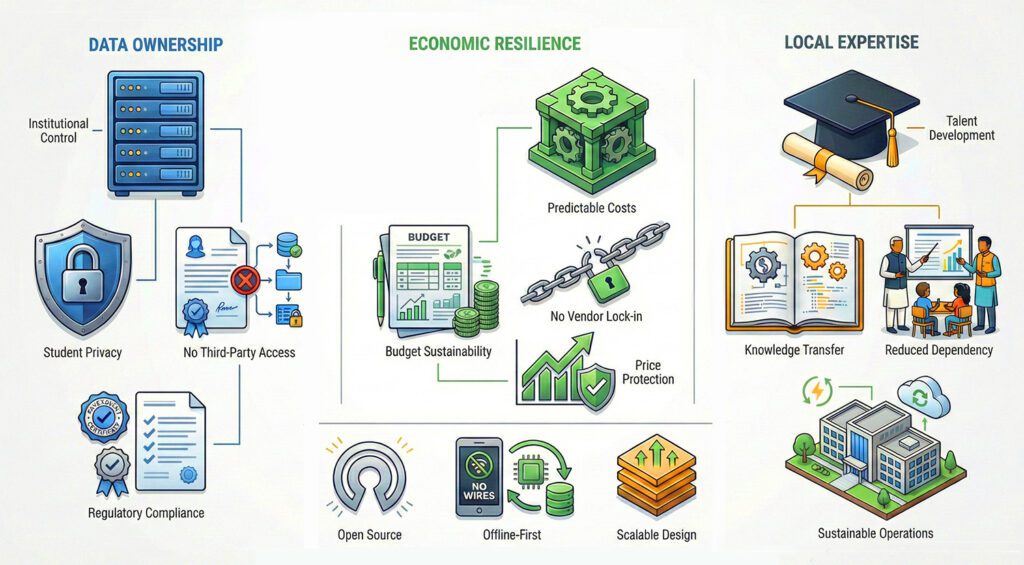
Disclaimer: This infographic was generated using AI tools.
Frugal AI in Practice: The Teacher-in-the-Loop
How does this look in the classroom? The Teacher-in-the-Loop (TiL) model demonstrates Frugal AI by keeping educators at the centre of the workflow.
In this model, AI handles routine, high-volume tasks like translation, formatting, or initial content tagging, while teachers review and approve the output before it reaches learners. This calibrated approach solves two problems: it preserves professional judgment where it matters most, and it prevents the bottlenecks that make fully human-centric systems hard to scale.
Resilience is the cornerstone of the TiL architecture. Designed for the specific realities of small island developing countries and low- and middle-income countries, our system operates offline-first, relying on a local server arrangement that remains intact even if a disaster cuts off internet access. This allows teachers to continue their work locally and sync only when connectivity returns, ensuring that AI serves as a reliable lifeline rather than a bandwidth burden.
We view Frugal AI as the alignment and direct operationalisation of the seven chakras of the India AI Impact Summit 2026, which explore thematic areas of discussion and exploration. Our approach translates the summit’s high-level principles into actionable strategies for the Global South:
- Resilience, Innovation and Efficiency Chakra: By prioritising open-source infrastructure and low-resource adaptability, our focus on Economic Resilience answers the call for “frugal, energy-efficient, and sustainable AI,” ensuring viability in resource-constrained settings.
- Human Capital Chakra: Our pillar of Local Expertise shifts the paradigm from passive consumption to active capacity building. By integrating “Teacher-in-the-Loop” methodologies, we ensure the workforce is upskilled rather than displaced, directly supporting the summit’s goal of equitable workforce transition.
- Safe and Trusted AI Chakra: We anchor our framework in Data Ownership, ensuring that national sovereignty and student privacy are engineered into the system’s architecture from day one, rather than treated as regulatory afterthoughts.
In this way, Frugal AI serves as the practical “how”— the mechanism that turns the Summit’s guiding “Sutras” of People, Planet, and Prosperity into measurable, on-the-ground reality. Frugal AI is a framework for Education that will be led by COL across the Commonwealth – grounded in trust, inclusivity and sovereignty.