

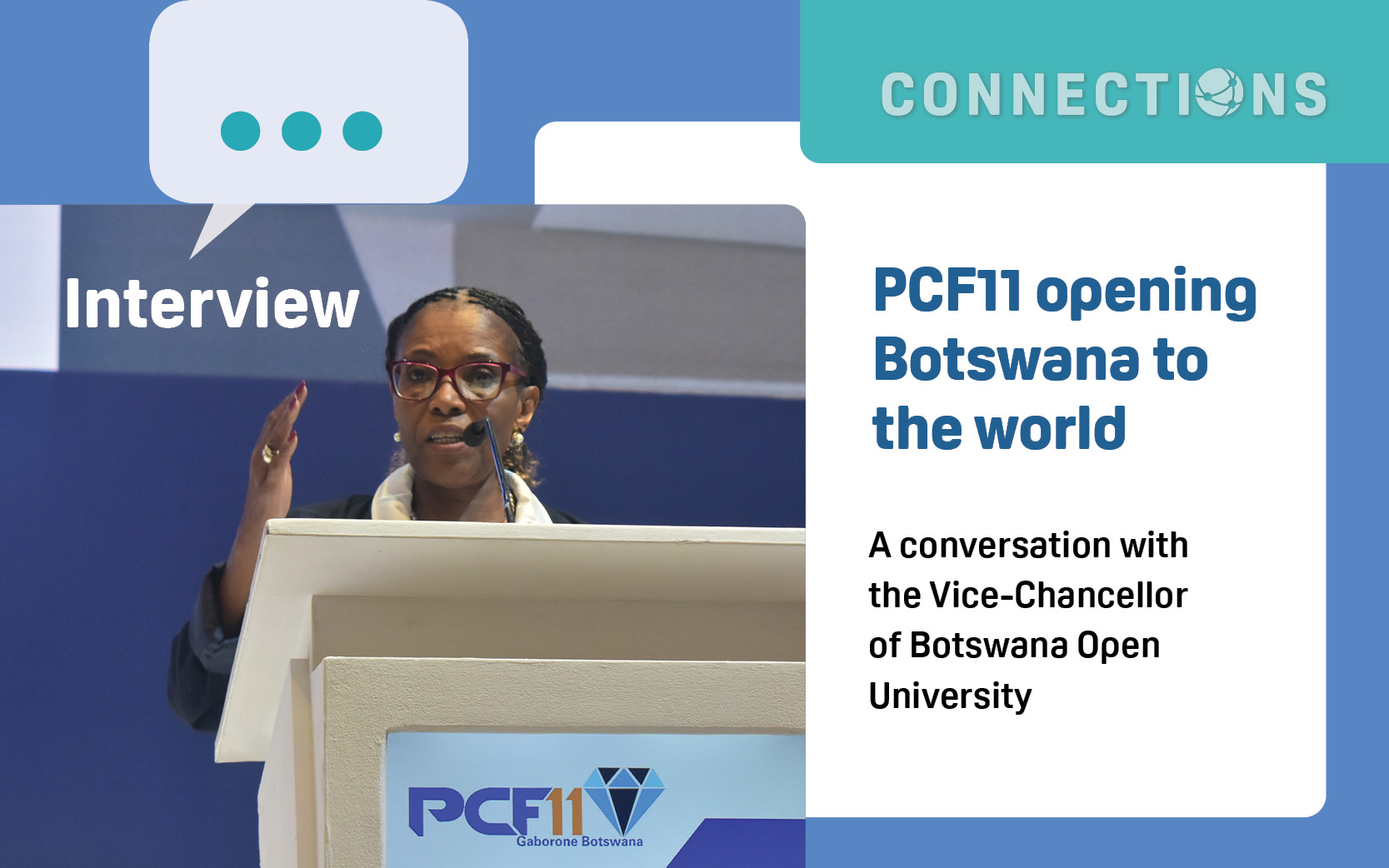
A conversation with the Vice-Chancellor of Botswana Open University
By Professor Kgomotso Moahi, Vice-Chancellor of Botswana Open University
As co-host and implementing agency of PCF11, Botswana Open University (BOU) delivered with COL and the Ministry of Higher Education one of the world’s most significant education gatherings on open learning. Following the Forum, Dean Pogas, Director: Strategic Engagement at COL, interviewed the Vice-Chancellor of BOU, Professor Kgomotso Moahi about the Forum, its national impact, and the legacy for open learning in Botswana and the Commonwealth.
Q: PCF11 was years in the making, with the Forum returning to Africa after nearly a decade. As the implementing agency for BOU and co-host with COL and Botswana’s Ministry of Higher Education, what has this experience meant for your university and the country?
We were humbled and honoured to have had the opportunity. The experience exceeded all our expectations. For BOU, it reaffirmed what we have always known — that when called upon, we rise to the occasion. With ten previous PCFs, each so successful and focused, we asked ourselves if we could live up to that high standard. But through the commitment and resilience of staff at BOU, and with support from COL and the Ministry of Higher Education, we did.
It cemented our position as an open university to be reckoned with, both regionally, across Africa, and internationally. We’re just eight years old, but we’ve now been placed firmly on the map. The conference gave us a platform to demonstrate our capabilities and reliability as a partner.
Equally important, it gave BOU colleagues and myself a chance to participate in discussions of global relevance, such as, artificial intelligence, micro-credentials, employability, and the shift from long academic programmes toward shorter, skills-based learning. We’ve also come away with new knowledge and confidence to advance Botswana’s Vision 2036 and for BOU to become a globally recognised university.
Q: PCF11 has been a truly inspiring gathering in Botswana, a nation rich in culture, heritage, and vision. With the Forum’s theme, ‘Innovation for Open Education: Fostering Resilient Societies for Economic Development,’ what has the reflection on education been for Botswana?
For the Ministry of Higher Education, PCF11 placed a spotlight on open education, an area that often receives less attention but is vital for ensuring access and inclusivity. The lead-up to the forum involved radio and television interviews that helped bring open and distance learning into the national conversation.
As the Honourable Prince Maele, Minister of Higher Education of Botswana put it, his Ministry has become a ‘ministry of firsts.’ For example, this was the first time since the current government took office that a ministry hosted an international conference of this scale. Beyond policy, such events have tangible benefits — they stimulate the local economy, support tourism, and open doors to collaboration. For me, it truly warmed my heart to see Botswana opened to the world through ODL.
Q: A number of Education Ministers from the Commonwealth came to PCF11, where we saw a high level of engagement, including in panel discussions, parallel sessions, and technical briefings. Key outcomes from PCF11 also culminated in the Gaborone Statement, in which seven Collective Actions were outlined. What is your reflection of these outcomes when it comes to the impact for Botswana?
The Gaborone Statement aligns strongly with our national priorities, such as equity, inclusivity, and access. These are central to our government’s human rights-based approach to education. Through open learning, we now see even greater potential to advance those goals. What we’re seeing is a shift from knowledge to skills in education — ensuring graduates are equipped to meet the needs of the economy. For example, Technical and Vocational Education and Training (TVET) has become a top priority for Botswana, specifically with a draft national TVET policy developed, and we’re revitalising technical education centres to attract more young people into practical, employment-creating pathways.
Bridging the digital divide as mentioned in the Gaborone Statement is equally critical. The government’s Smart Botswana project is expanding connectivity to schools, clinics, and community centres — these centres known locally as ‘kgotlas.’ These are village meeting places where people gather; we are equipping them to ensure they have the digital tools needed for learning. Indeed the Government is focused on digitilisation as a catalyst for economic development.
We are also working on authentic assessments where with the rise of AI, we’re exploring how technology can enhance inclusion and assessments — leveraging learner data to design fair, personalised evaluations rather than viewing AI as a threat. In addition, BOU has participated in the COL-AFTRA Beyond Numbers Project, aimed at scaling quality teacher development through through OER and ODL.
Q: From the keynotes and panels to the parallel sessions and networking activities, collaboration and partnerships were central to PCF11. What have been the learning moments that have crystalised possibilities for collaboration?
Listening to how others are tackling shared challenges was enlightening. It showed us that our struggles are not unique to Botswana and that solutions already exist. For example, during the Vice-Chancellors’ Forum, we heard from Vice-Chancellor, Professor Paloma Mohamed from the University of Guyana on their ‘Open AI’ policy, which is a practical framework that others can adapt. While Minister Sukon showcased the University of Mauritius’ national OER repository and work on a national micro-credentials framework. These exchanges showed that we don’t need to reinvent the wheel; the expertise already exists within the Commonwealth, and we can leverage that through partnerships and collaboration.
Q: In reflection on how much was accomplished at PCF11 and the ability to bring Commonwealth education stakeholders together — what do you hope delegates take away from PCF11?
I hope they are left with a deep sense of connection and possibility. Many of us gained new insights, even on familiar topics, through the exchange of ideas and best practices. I believe we achieved our objectives: to share experiences, learn from others, and forge partnerships for future cooperation.
On innovation, I was particularly struck by discussions on AI. If we can harness it correctly, AI can become a powerful tool for progress rather than something to fear. Technology is never neutral, but we can define how it serves us — making sure it benefits society as a whole with the proper guardrails.
Culturally, it was heartening to see delegates embrace Botswana — visiting local landmarks, wearing our national colours, and celebrating our traditions at the culturally-infused gala celebration. It’s a reminder that culture, education, and opportunity are deeply intertwined.
Finally, what moved me perhaps the most was the scale of participation — from His Excellency President Boko and members of Cabinet and Parliament, to diplomats and 18 Vice-Chancellors. I’ve attended many conferences, but have never seen one with that level of presence. It was deeply humbling and a powerful reminder of what we can achieve when we come together.
This interview was originally published in the November 2025 issue of Connections. Access the full issue here.