By Dr Karen Nyangara, Adviser: Gender
Today, and every year on 10 December, COL celebrates Human Rights Day. While the occasion reaffirms the values of human rights as set out in the Universal Declaration of Human Rights (UDHR), this year’s theme, Human Rights, Our Everyday Essentials, places specific emphasis on the human rights expressed through the lived experiences of all. As stated in the UDHR, a fundamental part of achieving human rights includes receiving an equitable education that supports the “full development of the human personality.”
Unfortunately, the realisation of human rights in education is hampered by persistent challenges. Disengagement from education, limited competencies for educational attainment, and rapid shifts in digital and STEM-related fields widen technological disparities and exacerbate disproportionate impacts on marginalised youth. COL works to reduce these inequities across the Commonwealth by enhancing access to quality lifelong learning with the overarching belief that learning supports progress towards achieving sustainable development.
During the eleventh Pan-Commonwealth Forum on Open Education (PCF11) in September 2025, seven collective actions were agreed upon in the Gaborone Statement to reaffirm the commitment of the Commonwealth to enhancing educational equity. The statement’s calls to action involve integrating gender equality and youth leadership into COL’s work to empower youth and other marginalised learners to find solutions to the challenges they face. In equipping students with the competencies to support the realisation of their human rights through education, the Gaborone Statement calls on all Commonwealth Member Countries to integrate flexible and accessible methods for all learners – especially girls and women, persons with disabilities, and other disengaged youth from marginalised communities.
At PCF11, COL Adviser: Gender, Dr Karen Nyangara, facilitated an interactive pre-forum session to explore effective approaches and key challenges in using participatory, community-based, and open learning methodologies for skills learning and empowerment. In the workshop, Dr Nyangara highlighted how the accessibility, flexibility, and agency afforded to learners through open and distance learning support learning for social development. She curated a series of real-world case studies to demonstrate how community-based learning, rooted in and driven by local needs, resources, and leadership, empowers young people to realise their full personality and become agents of change.
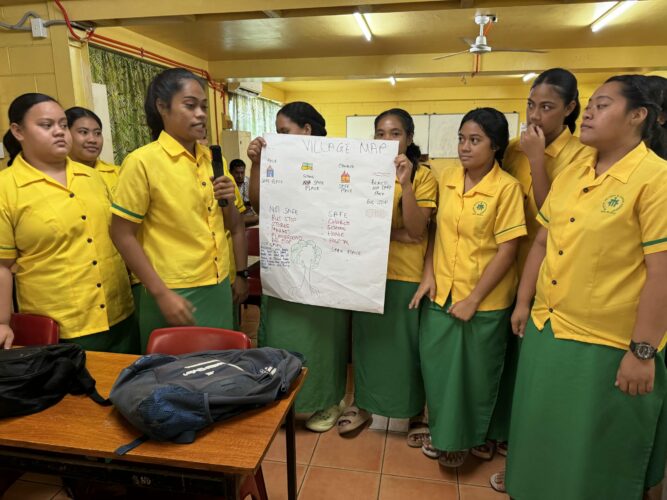
In the session, the NGO Brown Girl Woke shared their experience working with 30 out-of-school young women in Samoa on vocational skills training and gender empowerment. After observing that most participants demonstrated basic reading and writing skills during a text-heavy lesson, Brown Girl Woke shifted its pedagogical approach to a more participatory, culturally appropriate methodology, using role-play, pictures, demonstrations, and storytelling. This pivot strengthened participants’ leadership and self-efficacy, building their confidence and encouraging some to enrol in gender-atypical courses such as plumbing.
Another case study from Tanzania demonstrated how a gardening project at a learning centre helped girls returning to school gain transferable agricultural and commerce skills. Young mothers who struggled with intermittent attendance in trying to earn a living for their children became more engaged and achieved higher completion rates. Various academic presentations demonstrated further best practices for using micro-courses and eMobile learning solutions to develop context-specific and accessible learning modules in gender equality, financial training, and vocational skills.
The workshop was attended by a rich blend of civil society and academics from across the Pacific, Asia, and Africa and culminated in the co-creation of a powerful 3C Model for participatory and community-based open learning.
The 3C Model:
- Connects: Participants and practitioners collaborating in youth skilling and gender equality.
- Curates: Existing and new content to the specific local context where and when it is needed.
- Creates: Learning opportunities and methodologies shaped by a vision for youth-led outcomes.
By centring the voices of youth and other marginalised groups, COL aims to empower all learners to be at the heart of scalable, sustainable social change. On this day, let’s reaffirm our commitment to using education as a tool for human rights.