

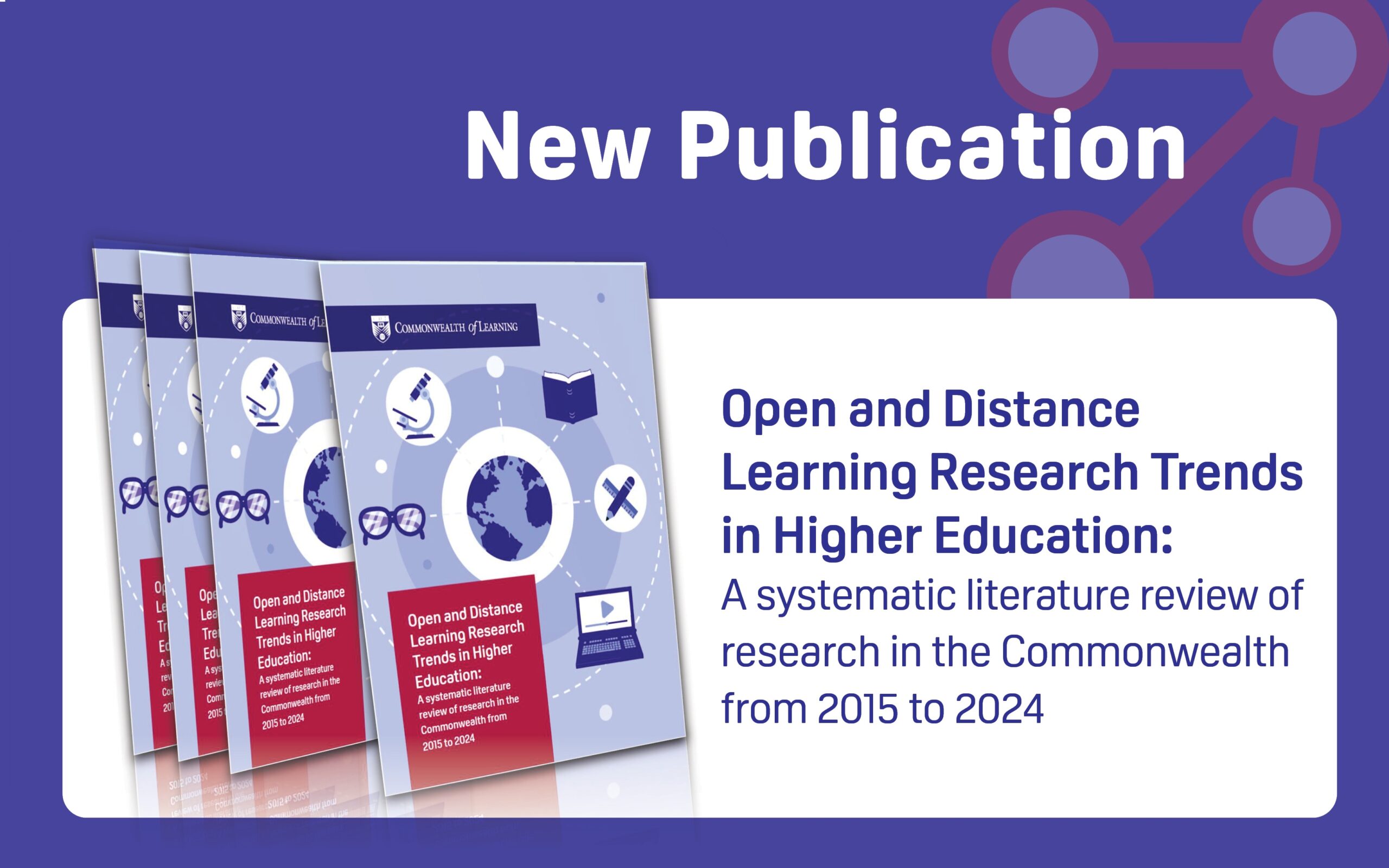
The Commonwealth of Learning (COL) has just published a new report titled Open and Distance Learning Research Trends in Higher Education: A systematic literature review of research in the Commonwealth from 2015 to 2024. Offering a decade-long view of how research on Open and Distance Learning (ODL) in higher education has evolved across different Commonwealth member countries, the report highlights growth areas and identifies research gaps.
Dr Jako Olivier, COL Adviser: Higher Education said, “The report shows that ODL research has grown substantially in Commonwealth countries, driven by technological advancement, changing education policies and the demand for more inclusive learning pathways.”
Several major trends are explored, including an uneven geographic distribution of research activity, a disproportionate focus on micro-level research, technological innovation, and socio-political impact. For instance, the shift to online learning during the COVID-19 pandemic was a particularly strong driver of research output in ODL, with publications increasing significantly from 2021 to 2024 and the number of articles peaking in 2022. Similarly, the integration of artificial intelligence, virtual reality, and augmented reality tools to enhance distance education environments is also observed.
In terms of geographical distribution, among 3,129 articles identified across 31 of the Commonwealth’s 56 Member Countries, research from only six countries accounts for over 80 per cent of research activity. Of these six countries, Australia (579) leads the Commonwealth in the number of SCOPUS-indexed articles published between 2015 and 2024, followed by the United Kingdom (575), Malaysia (496), India (374), Canada (287) and South Africa (283). With fifteen Commonwealth countries publishing fewer than 10 articles, the review indicates the need for expanded ODL research and pathways into international publishing in Asia, the Pacific Islands, Africa, and the Caribbean.
An analysis using a modified Zawacki-Richter ODL research framework further revealed that 77 per cent of publications relied on micro-level approaches, primarily focusing on learner characteristics and local educational contexts. In contrast, macro-level research on system-wide policy and regulatory frameworks, as well as meso-level research on organisational governance, costs, quality assurance, and Open Educational Resources, remains underexplored. Significant gaps are also evident in theory-building and policy-relevant scholarship, with fewer than four per cent of articles addressing theoretical or global issues. Despite these blind spots, ODL research has become increasingly interdisciplinary, spanning health, technology, and the social sciences. Increased collaboration and theory-grounded studies present positive developments that keep the research field cohesive.
COL invites policymakers, researchers, and practitioners to use the report’s findings to guide future priorities and investments in ODL across the Commonwealth. Download the full report here: https://hdl.handle.net/11599/6105.