
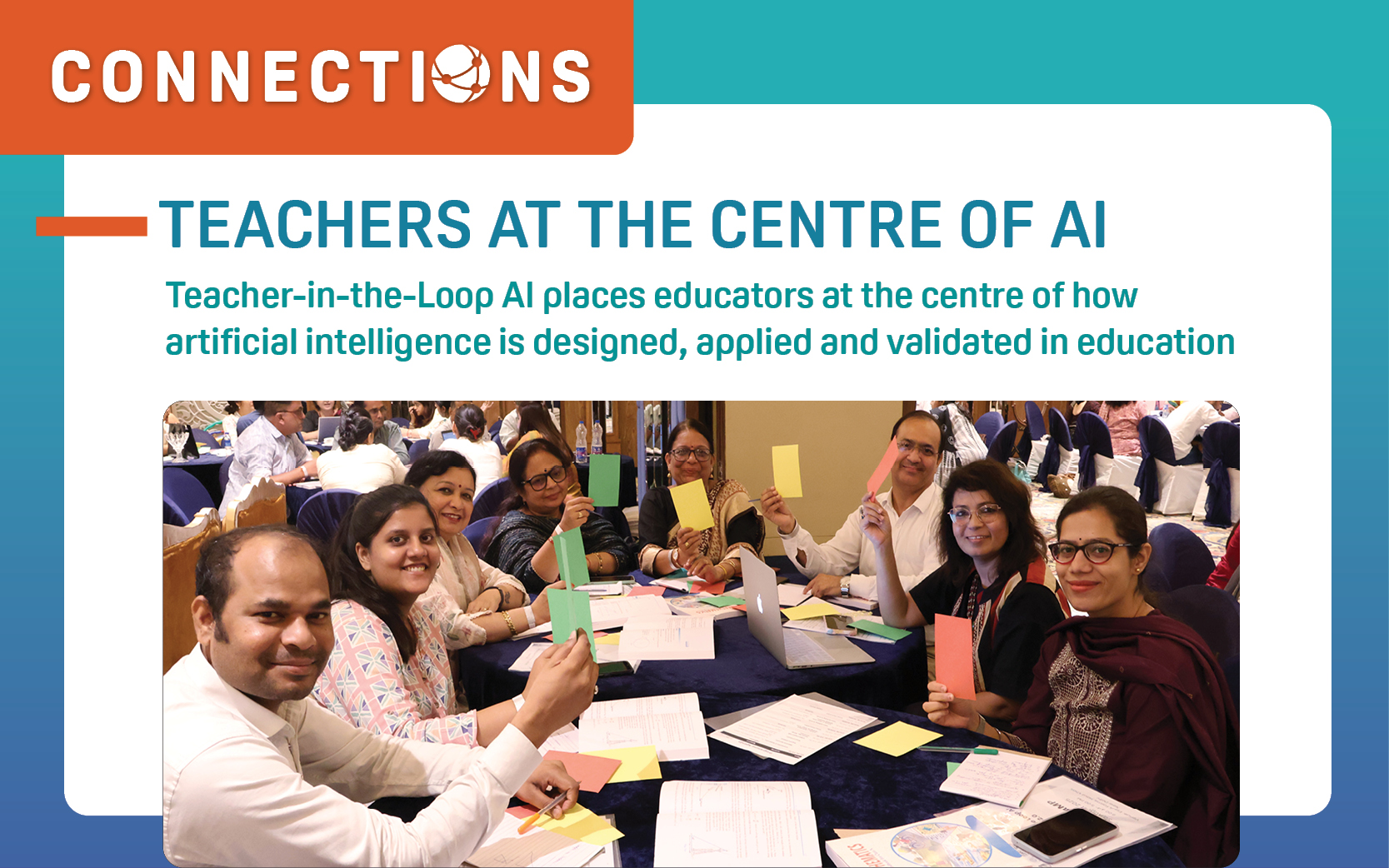
COL’s Teacher-in-the-Loop-AI (TiL-AI) project has reached an important national milestone in India, with 180 secondary mathematics teachers recently demonstrating improved use of Generative AI to create curriculum-aligned learning materials. This is not superficial engagement but transformative. Teachers are applying AI tools in ways that directly support their national curriculum, strengthening both content relevance and instructional quality.
This project, implemented in collaboration with the Central Board of Secondary Education, the Council for the Indian School Certificate Examinations, and other key stakeholders, has seen teacher engagement extend well beyond improved technical use of AI tools. The professional role of teachers within the model has evolved significantly, positioning them as active contributors to design, validation, and quality assurance.
These teachers are now functioning as co-designers, validators, and quality filters of AI-generated learning resources, staying at the centre of learning. Rather than relying on automated outputs, teachers remain at the centre of learning, actively reviewing, refining, and contextualising materials to ensure pedagogical integrity. This has strengthened professional agency and reinforced the principle that AI should augment, not replace, teacher expertise.
Institutional recognition marks another major achievement. Forty hours of TiL-AI training have been formally recognised toward the mandatory 50-hour annual teacher professional development requirement in India. This alignment with national career and professional development structures signals that the initiative is gaining systemic legitimacy and is no longer operating at the margins of innovation.
However, as the model scales, sustaining structured mentoring and continued institutional recognition will be essential. Without deliberate support mechanisms, there is a risk that quality assurance and professional ownership could weaken under the pressure of expansion.
This story was originally published in the April 2026 issue of Connections. Read the full issue: https://hdl.handle.net/11599/6130