

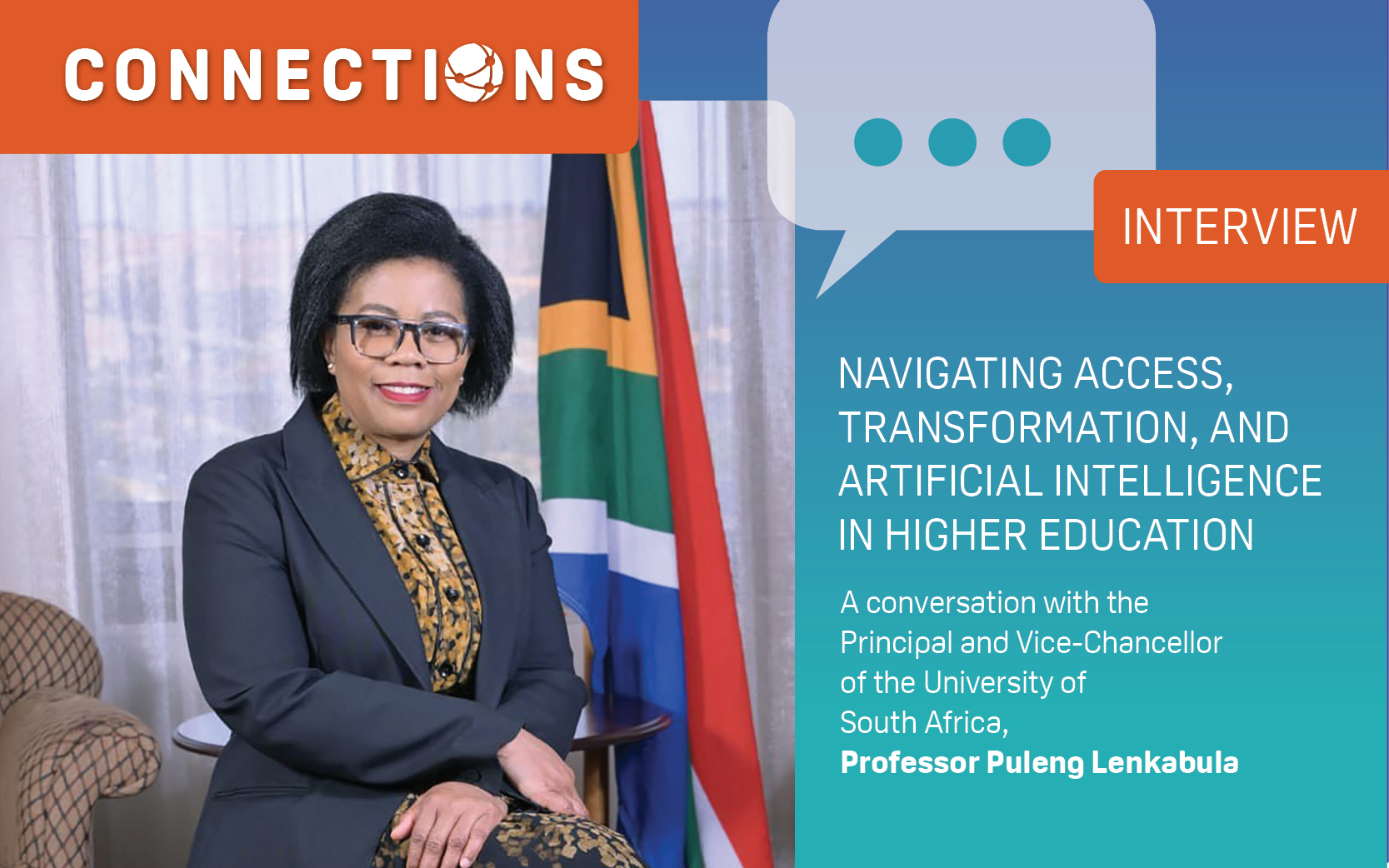
The University of South Africa (UNISA) offers a distinct perspective on higher education in Africa, shaped by its long history, expansive reach, and commitment to access — from widening participation at scale to responding to the rapid rise of artificial intelligence. In the latest issue of Connections, Dr Jako Olivier, COL Adviser: Higher Education, speaks with Professor Puleng Lenkabula, UNISA’s Vice-Chancellor, about the institution’s evolving role, including its approach to AI governance, safeguarding academic integrity, and advancing Africa-centred knowledge systems in a shifting digital landscape.
Q: With UNISA’s roots dating back to 1873, it is considered the oldest open and distance learning institution in the world, and it is the largest university on the African continent. As one of the growing number of mega-universities worldwide, what, in your mind, makes UNISA unique?
Besides being the world’s first and oldest distance education university, the University of South Africa has many other attributes that set it apart, both regionally and globally.
UNISA is the only mega university in South Africa and the largest on the African continent. It is not only large in terms of student numbers, but also has a truly global reach, with a presence in more than 100 countries.
Beyond scale and reach, the university has a significant impact on social transformation. Alongside its research impact, as reflected in the Times Higher Education Impact Rankings on the SDGs, UNISA is also one of the most accessible universities in terms of cost, geography, and technology platforms through its delivery model. This model continues to enable students from poor and working-class families to access university education.
UNISA is also the only South African-based university with a campus outside the national borders — the Ethiopia Regional Learning Centre, which attracts many students from East Africa and beyond. In this sense, it is the preeminent science diplomat in South Africa’s higher education sector.
There are also areas where, while not unique, the university has a clear competitive edge. Recently, the university adopted the Catalytic Niche Areas, representing a new research, teaching, and learning pivot for UNISA, to increase research output and realise local and global impact.
The university is also increasingly becoming unmatched in its convening power. Many significant and historic national dialogue events are held at UNISA, and it’s seen as an excellent space for national and international dialogues that shape humanity’s future.
Q: In a recent article on News24, you noted a marked increase in generative AI use, raising concerns about academic integrity. What are the main concerns in terms of AI use for UNISA?
The concerns are similar to those of any university in the world.
AI is new, complex, and changing far more rapidly than any other technological advance in history. While it is both welcome and unavoidable, and brings clear efficiencies to education and the workplace, it also raises several important concerns. These include ethics and the use of AI in academic work; quality assurance-related matters; the impact of AI on assessments; the impact on cognitive and analytical skills; AI and the nature of human beings; AI and value systems; culture; ideas, and much more.
At UNISA, we are also concerned about the control and ownership of smart technologies, including AI. The African university needs to respond to the danger posed by AI, which can be deployed to control, dominate, and subdue whole societies in the age of big data. But I believe as Africans, we will find the responses and preserve our freedoms, independence, and sovereignty.
Q: What is UNISA doing to address issues around the use of generative AI by staff and students, especially in terms of the open and distance nature of the institution and its stakeholders?
In response to the growing influence of generative AI, UNISA is exploring and implementing a range of policies and initiatives to address its impact across learning, teaching, research, and engaged scholarship.
For example, the College of Education was the first to implement AI policies and guidelines, influencing the entire university to engage with AI proactively, constructively, and strategically.
Within a relatively short period, the university has developed clear AI policies outlining acceptable use, ethical considerations, and accountability mechanisms for both staff and students. These are designed to enable, rather than restrict, supporting the responsible integration of AI across teaching, learning, and research. UNISA also continues to invest in robust proctoring solutions, including the Invigilator system, Moodle, and the IRIS Invigilation app, to safeguard the integrity of assessments in an online environment.
Beyond compliance, UNISA is leveraging AI to enhance the student experience and institutional efficiency. Efforts are underway to deploy AI-driven communication platforms and intelligent chatbots to improve response times and provide real-time support to students. Simultaneously, we are enhancing LMS platforms to detect and prevent plagiarism in increasingly sophisticated forms, taking a balanced approach that protects academic standards while embracing innovation.
Q: For UNISA, curricular change that centres Africa-based knowledge systems and advances transformation and the decolonisation of scholarship is clearly important. How do you see AI shaping this work?
UNISA’s vision is to become a truly African university, shaping futures in the service of humanity. One concern is that many AI models are trained on predominantly Western datasets, which may marginalise African epistemologies, languages, and perspectives. If not addressed deliberately, this risks reinforcing existing inequalities. For a university committed to decolonisation, it is therefore essential to engage critically with AI technologies rather than adopt them passively.
At the same time, AI offers unprecedented opportunities to amplify African scholarship and knowledge production. UNISA is actively exploring how AI can be used to digitise indigenous knowledge, support multilingual education, and expand research outputs rooted in African realities.
By integrating AI into curriculum reform and research innovation, the university is ensuring that technology serves as a tool for intellectual liberation rather than a limitation. This approach aligns with our broader transformation agenda, positioning Africa not just as a consumer of knowledge but as a producer and global contributor.
A central concern remains the dominance of European and Western knowledge systems in academic and information spaces. Africa needs AI that responds to and develops solutions for Africa, by Africans, ensuring that technological advancement is inclusive, locally grounded, and responsive to the continent’s unique development imperatives.
Q: With the rapid evolution of artificial intelligence, institutions are increasingly concerned about digital data and sovereignty. Approaches such as COL’s Frugal AI prioritise efficiency, local ownership, and compliance with national regulations. How is UNISA addressing these challenges?
As noted earlier, UNISA approaches digital sovereignty as a critical part of its transformation agenda. The risks associated with conventional cloud-based AI are being addressed through a deliberate shift towards more locally relevant and sustainable solutions.
The university is exploring frugal AI approaches that prioritise efficiency, affordability, and local ownership, ensuring alignment with national and continental priorities.
A key pillar of this strategy is the development of advanced internal capabilities, including the anticipated Quantum Solution, which will support work in quantum algorithms and advanced data processing. This is complemented by investments in AI-driven surveillance and access control systems to enhance campus safety, as well as secure data infrastructures to protect sensitive information.
Through bringing innovation and sovereignty together, UNISA is not only mitigating risk but also positioning itself to build resilient, future-ready digital ecosystems that serve both institutional and societal needs.
This interview was originally published in the April 2026 issue of Connections. Read the full issue: https://hdl.handle.net/11599/6130.