

Generative artificial intelligence (AI) has become part of everyday life in higher education. Students are using it to write assignments, teachers are using it to develop lesson plans, and many institutions are now using AI tools to answer student questions. As the use of AI tools grows, so too do concerns about their ethical, accessible and informed use.
Conversational agents are one of the many AI tools being adopted by colleges and universities to support teaching, learning and student services. While they may seem like a new development, their roots stretch back more than 50 years, to the earliest educational expert systems and hypermedia prototypes. As AI-enabled interfaces that interact with people through text, voice or avatars, conversational agents learn from data and human-computer exchanges to act as assistants, tutors or administrative support tools.
When used responsibly by higher education institutions, they can reduce administrative burdens and routine work, personalise support, improve feedback, strengthen student confidence, and help students receive more timely assistance. These potential benefits, however, must be weighed against the risks of inaccuracy and bias. Conversational agents are limited by the quality of the data they use, and require human oversight, staff training and regular evaluation to maintain ethical standards of use.
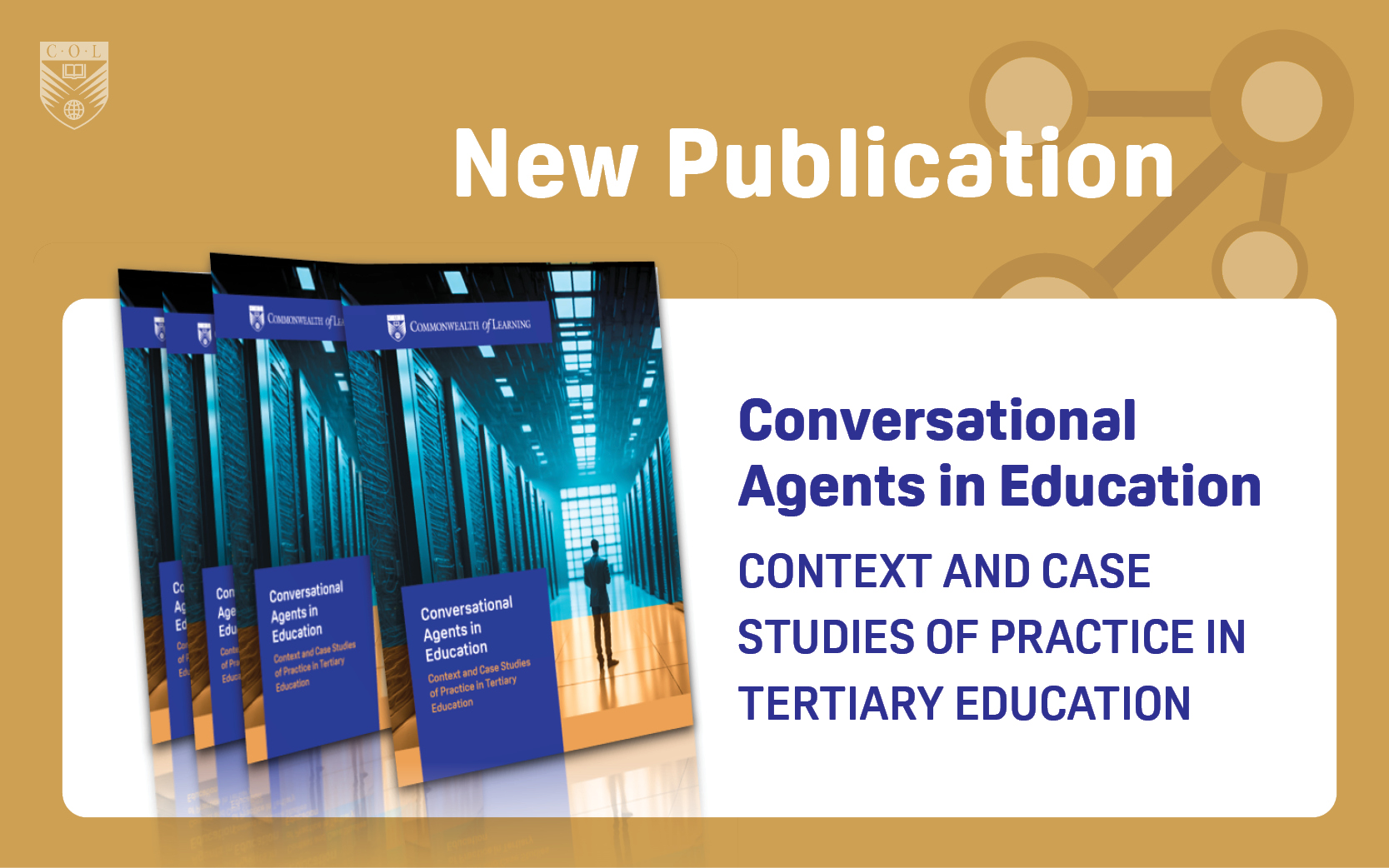
In COL’s new publication, Conversational Agents in Education: Context and Case Studies of Practice in Tertiary Education, Sara de Freitas and Denise Whitelock, both of The Open University, UK, examine the use of conversational agents in tertiary education and explore how they can support learning, teaching and student services. At a time when institutions need guidance on ethical and evidence-based practice that goes beyond the excitement surrounding new technologies, the publication offers timely insight into the development and current use of conversational agents within UK higher education.
The authors played formative roles in shaping early approaches to intelligent tutoring and computer-based dialogue systems in the 1970s, bringing deep knowledge of the histories that have shaped the use of conversational agents today. Drawing on decades of research in Artificial Intelligence in Education (AIED), the report traces the historical evolution of these systems, analyses their pedagogic and operational roles, and presents UK-based case studies that demonstrate their application in real institutional settings. These case studies include examples ranging from simple text-based assistants to more advanced systems using animated avatars, and unpack benefits such as personalised learning guidance, improved student engagement, and more efficient information retrieval and administrative processes.
Drawing on these case studies, the resource illustrates how conversational agents can be implemented effectively and feasibly, even in institutions with limited resources. This work aligns closely with COL’s vision for Frugal AI, which refers to artificial intelligence that is open, affordable, lightweight and capable of running in low-resource or offline environments. Unlike large proprietary models that require extensive cloud infrastructure, conversational agents can be built using smaller, modular or open-source frameworks; hosted locally; adapted to local languages and contexts; and deployed in institutions with limited connectivity. For institutions seeking digital sovereignty in resource-limited settings, conversational agents offer a practical way to adopt AI while maintaining control over their own systems, data and priorities.
The publication also reflects core principles of the Gaborone Statement, which calls for equitable, ethical and human-centred approach to AI. By demonstrating how conversational agents can augment, rather than replace, educators, the report highlights their potential to enable personalised support without costly infrastructure and to provide systems that are transparent, adaptable and locally governed.
Far from being a distant future technology, these well-established systems offer a practical and human-centred way to support learners across the Commonwealth. Our aim is for this publication to serve as an evidence-based resource for educators, leaders and policymakers considering how conversational agents might enhance teaching, learning and student support, and for it to contribute to wider discussions about responsible and inclusive AI adoption in education.
Read the full report: https://hdl.handle.net/11599/6140
* One of the report’s authors, Denise Whitelock, is a former COL Chair.