

By Dr Evode Mukama, Adviser: Teacher Education, Commonwealth of Learning
No technology, policy or platform can transform education without teachers. As a Commonwealth intergovernmental organisation that helps governments and educational institutions expand access to open learning through innovative technologies, the Commonwealth of Learning (COL) has seen this time and again: lasting change in education depends on teachers being at its centre.
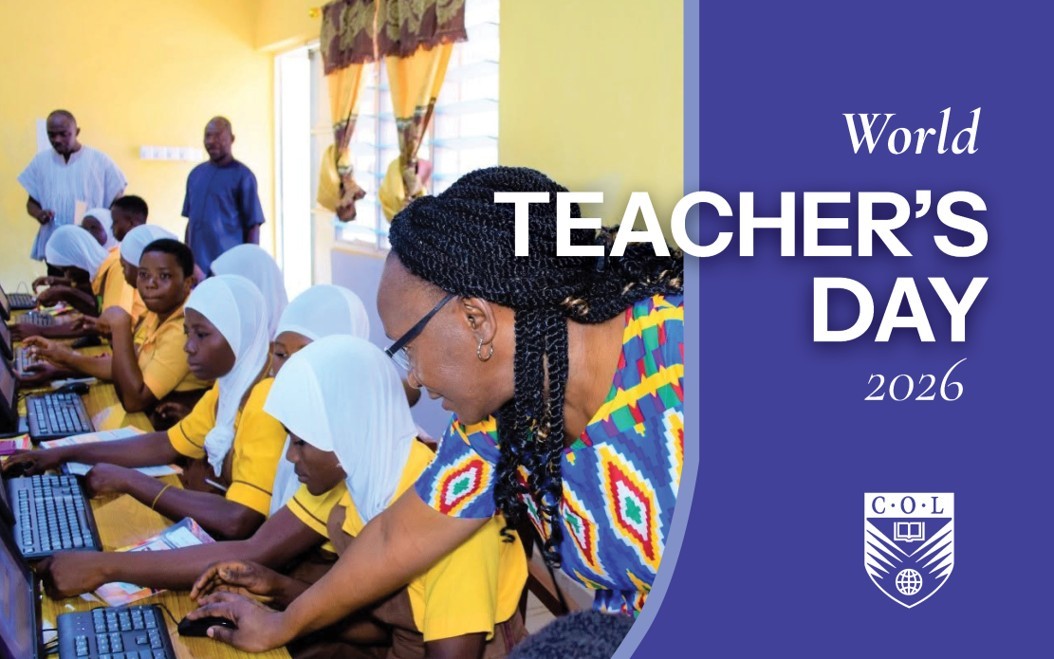
This year’s World Teachers’ Day theme reflects the same idea: “Standing with teachers: 60 years of protecting the profession, advancing its status and shaping our futures.” Marking the 60th anniversary of the 1966 ILO/UNESCO Recommendation concerning the Status of Teachers, this year’s celebration highlights the need to protect, promote, and elevate the teaching profession. It also comes as teacher shortages grow, with UNESCO estimating that 44 million additional teachers will be needed globally by 2030 to achieve universal primary and secondary education.
For COL, standing with teachers means investing in their professional agency, leadership, digital competencies, and continuous learning, and ensuring that learning is recognised. Through open and distance learning (ODL), open educational resources (OER), and technology-enabled learning, we help teachers build the confidence and professional judgement to navigate emerging technologies and create opportunities to learn from one another. Guiding this work is a simple principle: ‘nothing for teachers without teachers.’ It shapes how we work with teachers and their institutions to develop scalable models of professional development that treat teachers as agents of change.
Empowering teachers through lifelong learning and emerging technologies
The rise of AI, alongside advances in educational technology, is reshaping how teachers learn and teach. Whether through pre-service teacher education, continuing professional development or other flexible lifelong learning pathways, teachers must be able to upskill and reskill throughout their careers to keep pace with change and ensure that education continues to expand people’s agency in shaping their own futures.
Our approach to teacher professional development starts from that reality. In 2025, we began working with partners in the Caribbean and Africa on AI for Teacher Education, helping teachers and teacher educators build the knowledge, skills and confidence to use AI responsibly. Access to AI tools was only part of it; the bigger question was when AI actually helps in a classroom and when it doesn’t, and teachers are best placed to make those decisions.
During its first phase, regional partners worked towards developing AI curriculum and policy resources, including frameworks and codes of conduct. The work brought together countries and institutions across the Caribbean and East Africa, and shared lessons through regional professional platforms. COL will also focus on supporting the development of micro-credentials in AI education for teachers and teacher educators, while strengthening capacity and advancing approaches to the authentic assessment of AI-mediated learning.
Our Teacher-in-the-Loop AI (TiL-AI) initiative also places teachers at the centre of AI-supported education, equipping teachers and teacher educators to use generative AI to create and adapt OER while retaining their professional responsibility for pedagogical design, contextualisation, peer review and quality assurance. In this model, AI augments rather than replaces teacher expertise, enabling educators to develop curriculum-aligned, inclusive and locally relevant learning resources at scale.
Together, these initiatives reinforce the importance of teachers’ professional judgement as technology evolves. Teachers need the knowledge to use AI critically and ethically, as well as the confidence and professional autonomy to make informed decisions about when and how to use it in teaching and learning.
Strengthening teachers through collaboration and professional learning
A similar principle underpins COL’s work in Science, Technology, Engineering, Arts and Mathematics (STEAM).
Since 2022, we have supported partners to integrate virtual laboratories and computer simulations into STEAM teaching, strengthening teachers’ pedagogical and digital competencies. In 2025–26, this work was carried out with partners including the Africa Federation of Teaching Regulatory Authorities (AFTRA), the South African Council for Educators, the Botswana Teaching Professionals Council, the Uganda National Institute for Teacher Education, the Jamaica Teaching Council, and the Ministry of Education, Culture, Science and Technology in Belize. The STEAM teaching initiative demonstrated the value of combining technology-supported pedagogy with communities of practice and networked professional leadership. In Belize and Jamaica alone, more than 950 teachers participated in the initiative between December 2025 and February 2026.
The significance of this work extends beyond access to digital resources. It builds teachers’ capacity to create, adapt, evaluate and share resources that respond to their own classroom contexts, while opening opportunities for them to take on wider roles as resource developers, facilitators, trainers and professional learning multipliers.
As Mapula Ella Mokgalane, Chief Executive Officer of the South African Council for Educators, noted:
“The programme is not simply about providing resources; it is about developing people who can multiply their impact. Representatives of Teacher Communities of Practice are being equipped to serve as resource developers, facilitators, trainers and professional learning multipliers, enabling them to support other teachers in confidently using, adapting and sharing virtual-lab-supported STEAM resources.”
This emphasis on collaborative professional learning extends across COL’s wider teacher education work. From 2024–2025, we worked with AFTRA to implement the Beyond Numbers model in six sub-Saharan African countries, strengthening national ODL frameworks and co-developing digital literacy modules for teachers. The initiative also strengthened teachers’ digital competencies in line with global standards, including UNESCO’s ICT Competency Framework for Teachers and AI Competency Framework for Teachers. Through the Network for Open Teachers Education in Sub-Saharan Africa (NOTES), collaborative teacher education is driving the co-creation and use of OER across five Commonwealth countries, supported by digital technologies and communities of practice.
These experiences show that good professional development does more than build skills. It strengthens teachers’ confidence, collaboration and leadership, as well as preparing them to respond as their learners’ needs change.
From participation to professional recognition
Standing with teachers also means recognising the learning they undertake throughout their careers. Micro-credentials offer one way to do this, providing more flexible and transparent pathways for lifelong learning.
The Commonwealth Micro-credential Framework for Lifelong Learning, developed by COL through research and consultation with governments, qualification and quality-assurance agencies, educational institutions and other stakeholders, sets out principles for this work. These include quality assurance, recognition of prior learning, portability, learner-centred design and the potential for micro-credentials to count towards wider qualifications.
For teachers, this creates an opportunity to move beyond professional development that is simply completed and recorded as attendance. Quality-assured micro-credentials can provide evidence of specific knowledge, skills and competencies and can potentially contribute to broader learning pathways. This strengthens the professional recognition of teachers’ continuous learning.
At the opening of the micro-credentials policy development process at the University of Seychelles and the Seychelles Institute of Teacher Education in September 2026, Mr David Pierre, Minister of Education and Human Resource Development in Seychelles, highlighted the importance of maintaining credibility as more flexible forms of professional learning emerge. He emphasised that micro-credentials for teachers must be properly designed, assessed, quality-assured, recognised and recorded, adding: “Quality must remain at the centre of micro-credentials for teachers; flexibility should never come at the expense of credibility.”
This principle is fundamental to advancing teacher status: professional learning must be both accessible and credible.
Standing with teachers, shaping the future
Across these areas, our experience shows that protecting and advancing the teaching profession requires sustained investment in teachers’ knowledge, skills, agency, leadership and recognition. Working with partners, we combine technology, open learning and collaborative professional development to create flexible pathways that help teachers keep learning, lead innovation and share their expertise.
Sixty years after the 1966 Recommendation, the work of supporting teachers as professionals continues. On World Teachers’ Day 2026, we stand with teachers by bringing these efforts together into a single approach to professional development, one built with teachers, not just for them.