

By Dr Karen Nyangara, Education Specialist: Gender, COL
Nafula, a 21-year-old student in Kenya whose name has been changed to protect her identity, has three dreams. “I want to be a language teacher, a road engineer, and a soldier,” she shares.
Today, she is working towards a future she once feared was out of reach.
At just 15, Nafula had to leave high school after becoming pregnant. With no legal action taken against the person responsible, her aspirations began to fade. “I was a child looking after another child,” she reflects.
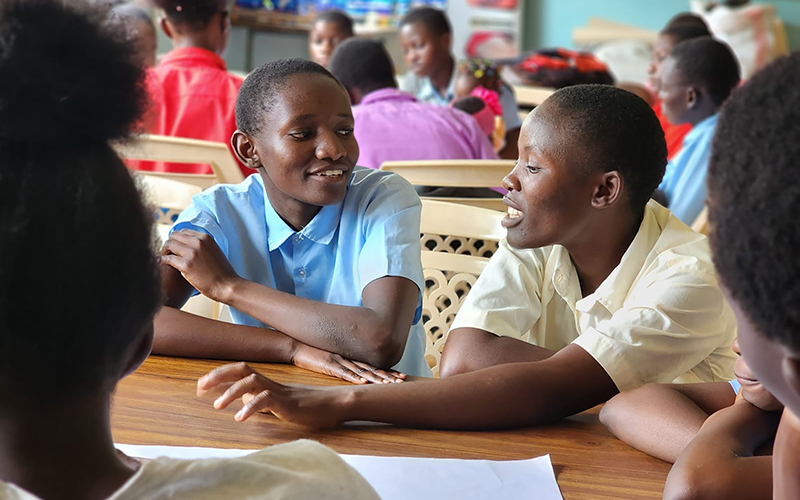
With support from the Rural Education and Economic Enhancement Program (REEP) in Kenya, a partner in the Commonwealth of Learning (COL)’s Girls Inspire initiative, Nafula’s parents were encouraged to enrol her back in school. Now among the top performers in her class, Nafula’s story is proof of what is possible when girls are supported to continue learning, and why safe and inclusive learning environments must remain a priority.
These challenges are at the heart of this year’s 16 Days of Activism. From 25 November to 10 December, the campaign calls on us to “UNiTE to End Violence Against Women and Girls: Ensure justice, protect survivors, end impunity.” The scale of the problem is immense. The World Health Organization (WHO) estimates that nearly one in three women, or about 840 million worldwide, have experienced partner or sexual violence. Among adolescent girls aged 15 to 19, an estimated 43 million have experienced intimate partner violence, non-partner sexual violence, or both. The consequences can extend far beyond the violence itself, affecting girls’ ability to continue their education, develop skills and pursue their ambitions.
Protecting the right to learn
COL believes that learning institutions and community spaces where non-formal learning takes place have a responsibility to help make education safe and accessible. Through initiatives such as Girls Inspire, the Empowering Women and Girls (EWG) project, and our wider gender mainstreaming efforts, we work with policymakers, institutions and civil society organisations to strengthen their capacity to develop policies and strategies that protect learners, support girls to return to school after pregnancy, equip teachers to prevent school violence and mentor learners, raise awareness about the rights of women and girls, and prevent gender-based violence. When girls are safe, they can learn. When they can learn, they can transform their lives and their communities.
REEP is putting this commitment into practice with the County Government of Busia, Kenya, coordinating with the County Gender Taskforce to develop a Sexual and Gender-Based Violence Policy. REEP is also advocating in communities and schools for every girl’s right to learn safely. Along with other partners from COL’s Girls Inspire initiative in Uganda and Tanzania, the organisation is supporting students and teachers to identify and map physical and psychological spaces where violence occurs. This participatory approach helps identify risks, while teachers receive training to develop guidelines for safe spaces and individualised implementation plans for each school.
Across Bangladesh, Malawi, Mozambique, Pakistan and Sri Lanka, COL’s EWG project has identified capacity gaps and trained school committees to strengthen their responses to gender-based violence (GBV), in line with global guidance on school-related gender-based violence. Through this work, the project is helping schools and communities create safer environments for girls and other vulnerable learners, equipping teachers to prevent GBV and establishing clear pathways for reporting incidents.
These interventions matter because learning is not a substitute for justice, protection or specialist support. Survivors should not be expected to make themselves safe through education alone or to carry the burden of ending violence. Rather, it is the responsibility of schools and communities to establish clear procedures for responding to disclosures, protecting confidentiality, respecting survivors’ choices, and connecting them with appropriate services. Policies are most effective when they are understood, resourced and put into practice, and when those responsible for violence are held accountable.
Making safety and inclusion part of learning
Creating safe learning environments also means recognising that risks extend beyond the physical classroom. Digital learning can connect girls to teachers, resources and new opportunities, but it can also expose them to harassment, threats or the non-consensual sharing of images. Ensuring their safety, both online and offline, requires clear standards for respectful behaviour, accessible reporting mechanisms, privacy-aware platforms and staff trained to respond appropriately and quickly. These measures must also account for the different barriers learners face, including those related to disability, age, poverty, location and access to technology.
The content of learning materials and how they are taught can also challenge the beliefs and unequal power relations that allow violence to persist. Gender-responsive teaching, for example, can challenge stereotypes, encourage respectful relationships and reinforce that equality is a shared responsibility.
At the National Institute of Engineering in Mysuru, India, faculty participated in a COL-supported programme that introduced gender-responsive teaching practices in engineering education. To encourage more equitable participation, students worked in mixed-gender teams, took turns in leadership roles and collaborated on hands-on projects. During laboratory sessions, lecturers also guided discussions on how responsibilities were shared and helped students develop skills in managing emotions and resolving conflict. The programme reported that female students took on leadership roles in laboratory activities 22 percentage points more often, while male students’ comfort with mixed-gender teamwork rose by 10 percentage points. The greatest improvement was among female students’ confidence in communication, demonstrating how changes in teaching practices can help create more inclusive learning environments.
A future free from violence and fear
Nafula’s story shows how returning to education can help reopen opportunities that once seemed lost. But ensuring that every girl has the same chance requires more than access to learning. It requires institutions and communities that actively protect learners, challenge discrimination, and respond to violence. Skills, knowledge of rights, and greater economic opportunity can widen choices, but they must go hand in hand with effective laws, survivor-centered services, and accountability.
This 16 Days of Activism, COL stands with partners across the Commonwealth to make learning safer, more inclusive and accessible. Every girl, like Nafula deserves to pursue her ambitions without fear.
Collective action can turn community-led solutions into national change. Explore our strategic talking point on Empowering Women and Girls : https://www.col.org/chogm26/tp14