

Teacher educators play a vital role in preparing teachers for a changing education landscape and shaping how future generations experience learning. As blended and online learning models become more widespread, teachers must continually develop their digital skills and adapt their practices to make effective use of emerging technologies. For example, a teacher who can critically evaluate an AI-generated lesson for accuracy or use AI to adapt an open educational resource (OER) for learners with diverse needs can make informed pedagogical decisions and create more inclusive, relevant and engaging learning experiences.
For the Commonwealth of Learning (COL), investing in teacher educators is a strategic way to strengthen the wider teaching profession, preparing new teachers for the future while supporting practising teachers to adapt and develop their skills. By building their own capacity in OER and AI, teacher educators can pass new knowledge on to those they train and support, promoting the responsible and effective use of emerging technologies in classrooms and improving the overall learning experience for students.
Realising the potential of teachers and trainers to co-create, adapt and share OER in an increasingly digital landscape, however, requires institutional capacity, responsible practice and collaboration.
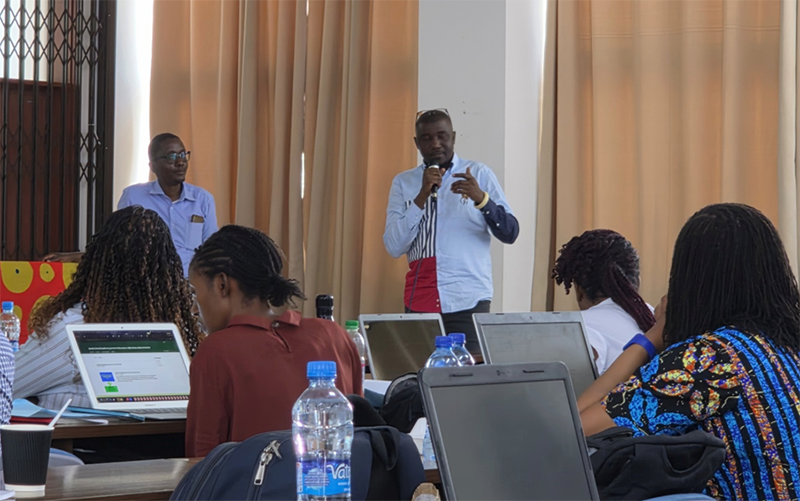
In this context, the School of Education at the University of Zambia (UNZA), with support from COL, brought together 38 participants for a workshop on Openness in Teacher Education in October 2026, with a specific focus on OER and generative AI.
An activity under COL’s Network for Open Teacher Education in Sub-Saharan Africa (NOTES), the workshop was anchored in a framework for OER in teacher education, developed with the participation of teacher educators from the region. The framework sets out a shared understanding across six domains: identifying the problem or need; educator capacity strengthening; exercising agency with OER; collaborative OER practice; infrastructure, access and supportive policies for sustainable OER; and fostering the practices, culture and identity of NOTES. Together, the domains connect educators’ needs and professional agency with the institutional conditions and network collaboration required to sustain open practice.
With the Wits School of Education at the University of the Witwatersrand serving as the lead institution for the Southern Africa Node, NOTES connects institutions and educators through a Network of Practice, so they can share expertise, co-create resources and learn from one another’s experiences.
Informed by a needs assessment report, the workshop combined foundational OER knowledge with practical sessions on finding, evaluating, adapting, creating, licensing and sharing resources. Participants also explored responsible generative AI use alongside accessible learning design, quality assurance and peer review. A distinctive strength was the involvement of internal resource persons from UNZA with complementary expertise in OER principles, resource discovery and curation, quality assurance, accessible learning design, copyright and open licensing, and responsible generative AI. Drawing on this institutional expertise supported co-creation and peer learning, while also strengthening local ownership and capacity for continued support beyond the event.
Highlighting Zambia’s contribution to a broader Network of Practice for Southern Africa, Dr Robinson Mambwe, Acting Dean of the School of Education at the University of Zambia, encouraged participants to share their experiences and learn from others across the region. “Let us therefore ensure that Zambian innovations and experiences are visible within the region, while remaining open to learning from our colleagues across Africa,” he said at the opening of the workshop.
Echoing this emphasis on regional collaboration, Dr Betty Ogange, COL’s Education Specialist for Teacher Education, highlighted the importance of co-creation in strengthening institutional capacity. “By enabling educators to develop and review resources together, we strengthen local capacity while building a community that connects learning, innovation and research across institutions,” she said.
The workshop established a starting point for continued hands-on OER training and AI and digital mentoring. With additional support from the African Deans of Education Forum (ADEF) to mobilise schools of education and academic leadership, these activities aim to strengthen institutional practice, support the co-creation of openly licensed resources, promote collaborative research and connect Zambian experience to the wider network.
These efforts also reflect priorities reaffirmed by leaders in the 2026 CHOGM Communique at the recent Commonwealth Heads of Government Meeting (CHOGM) in Antigua and Barbuda. The 2026 CHOGM Communique recognises the importance of providing teachers and institutions with the training, infrastructure and safeguards needed to adopt emerging technologies responsibly. Through NOTES, COL and its partners are translating these shared priorities into practical action, strengthening collaboration across institutions and supporting teachers to create more accessible and meaningful learning experiences.