

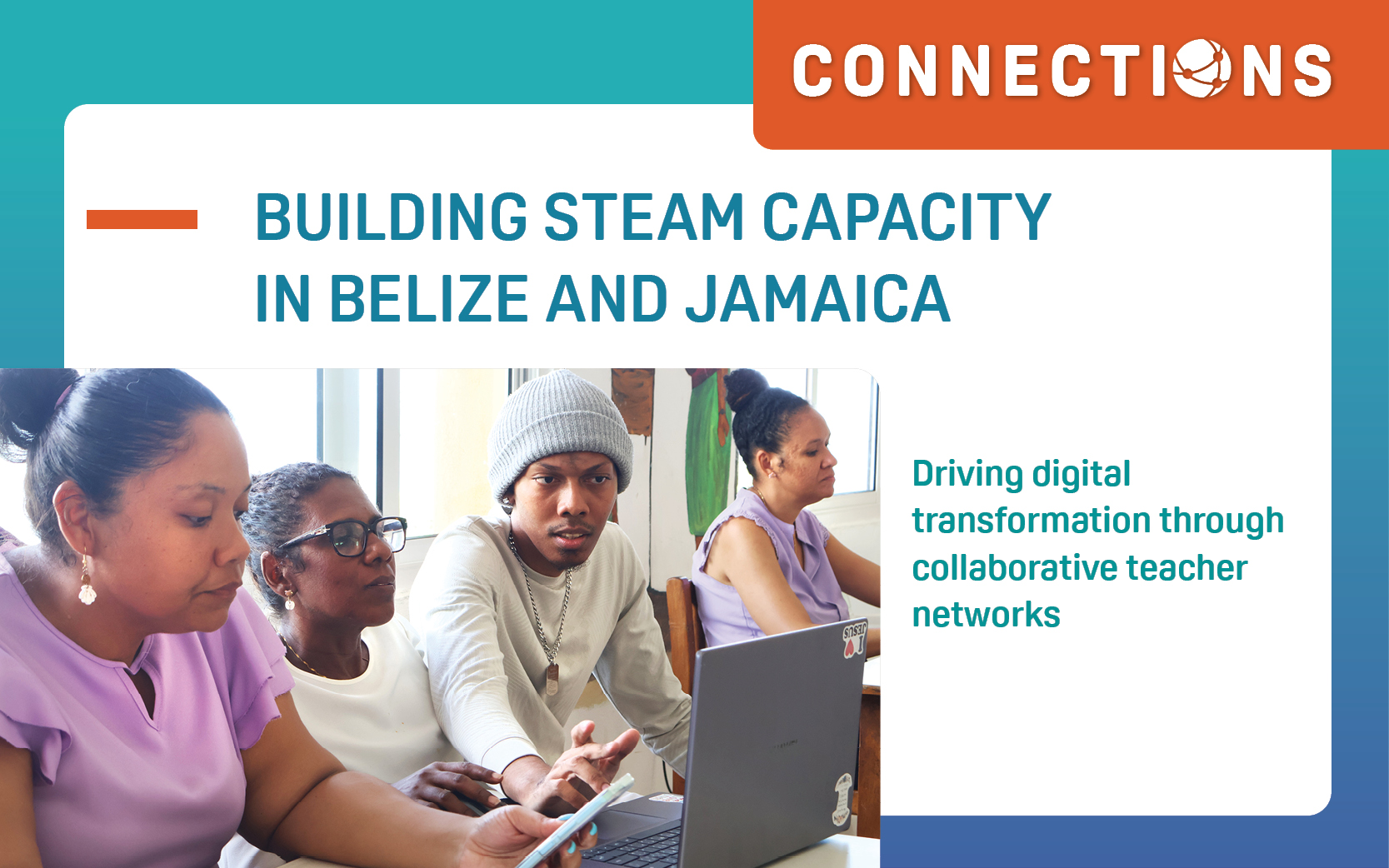
How can we bridge the gap between ambitious education policies and the realities of classroom practice in science, technology, engineering, arts, and mathematics (STEAM) within digital learning environments? While policymakers often envision ideal learning systems, it is teachers who must navigate the complexities of implementation in real classrooms.
Belize and Jamaica demonstrate what becomes possible when teacher capacity is meaningfully supported, benefiting not only educators but learners and education systems as a whole.
To address this persistent divide, the Ministry of Education, Culture, Science and Technology (MECST) in Belize and the Jamaica Teaching Council (JTC), in collaboration with COL, implemented a two-pronged collaborative approach: communities of practice for STEAM teachers and a model of networked professional leadership.
The STEAM Teachers Initiative rolled out this strategy from December 2025 to February 2026. It sought to deepen educators’ understanding of technology-supported teaching and learning across STEAM disciplines at the primary, secondary, and post-secondary levels. By February 2026, more than 230 teachers in Belize and 640 in Jamaica were actively engaged in the initiative, strengthening the practical application of digital approaches in classrooms.
From the outset, senior officials from MECST and JTC, alongside education leaders, including CEOs, registrars, and vice chancellors from Sub-Saharan Africa, helped define the initiative’s scope. Together, they guided the development of a course on integrating virtual labs in STEAM teaching, ensuring alignment with national policies and institutional needs.
This multilateral collaboration fostered partnerships among teacher education institutions, universities, and primary and secondary schools, bringing together pre-service and in-service teachers to support more co-ordinated digital transformation efforts.
To further strengthen this collaboration, COL hosted a series of sessions designed to foster dialogue, build a shared vision, and promote collective leadership across participating institutions.
In one of these sessions with education leaders, Cecilia Ramirez-Smith, Deputy Chief Education Officer at MECST, emphasised the need to shift “from individual excellence to collective intelligence, from isolated innovation to shared innovation, and from top-down reform to networked professional leadership.” She highlighted that when teachers are connected, innovation accelerates and classrooms become spaces for shared problem-solving, leading to more consistent and collaborative teaching practices.
Dr Winsome Gordon, Chief Executive Officer of JTC, emphasised the transformative role of AI, arguing that it offers an opportunity to reshape education systems towards greater inclusion and human development. Mr Dorrett Campbell of the Edna Manley College of the Visual and Performing Arts in Jamaica highlighted the vital role of the arts in STEAM, urging teachers to empower students to become creators and change-makers.
Participants echoed this collaborative spirit. One teacher proposed a global professional learning community where initiative participants could demonstrate their work. In response, COL is now supporting national and cross-institutional STEAM education communities of practice in Belize and Jamaica, with plans to extend the initiative to the Eastern Caribbean region, building on this momentum to scale collaboration and shared learning across contexts.
This story was originally published in the April 2026 issue of Connections. Read the full issue: https://hdl.handle.net/11599/6130.