

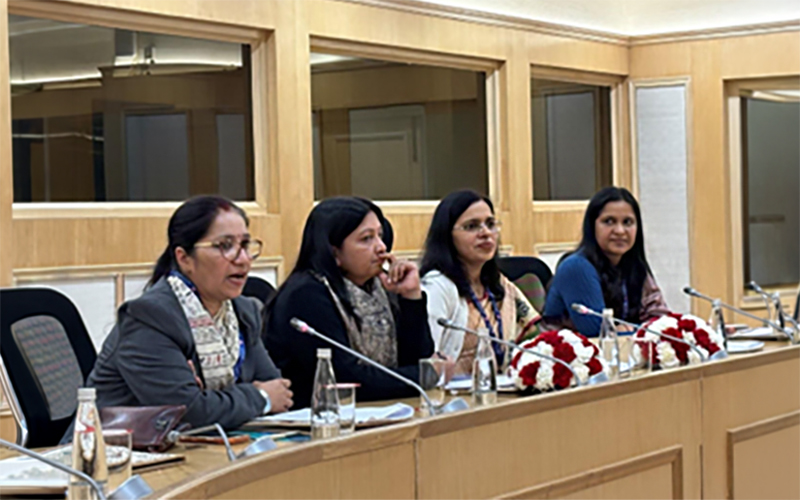
Emerging trends and challenges in Open, Distance, Digital and Blended Learning (ODDBL) took centre stage at the University of Delhi’s Campus of Open Learning’s International Conference recently. Organised in association with the National Assessment and Accreditation Council (NAAC) and the British Council, with support from the Commonwealth Educational Media Centre for Asia (COL-CEMCA), and the International Association of Technology and Management, the conference brought together educators, scholars, policymakers and business executives to reimagine the education landscape for higher education in their local contexts.
Keynote addresses and conversations centred around topics relating to AI for personalised and flexible learning, automated evaluation and feedback, ethical and policy considerations in ODDBL, and the role of blended learning in strengthening student engagement and employability. Presenters considered mobile learning, innovative assessment methodologies, digital literacy, infrastructural challenges, and cross-cultural collaboration for more inclusive and equitable education solutions.
Representing COL, Dr Tony Mays, Director: Education, along with Dr Basheerhamad Shadrach, Director of COL-CEMCA, both attended the conference to engage with international experts on the latest research, policy and practice in ODDBL. Delivering a keynote presentation for a session on quality concerns in distance and digital learning, Dr Mays argued that ODDBL providers should take the lead in developing quality criteria and indicators to regulate their practice.
“Ultimately, regulation is not about conformity to checklists. Quality is assured only when a community of practice works collaboratively to build and sustain a culture of quality focused on continuous improvement,” he says.
The session, which was chaired by Professor Ghanta Chakrapani, Vice-Chancellor, Dr. B.R. Ambedkar Open University and presided over by Dr Shadrach of COL-CEMCA, brought together voices from different countries and institutions.
Dr Ganesh Kannabiran, Director, NAAC, India, noted that while regulators need to become familiar with ODDBL provisions to develop appropriate quality guidelines, they must also address cross-cutting expectations such as national needs and graduate employability. Professor Linda Amrane Cooper, Director, Centre for Online and Distance Education (CODE), shared that while the UK makes no distinction on whether qualifications are obtained in-person or through ODDBL, both providers are subject to the same rigorous quality assurance standards.
At a later session on UCG regulations for distance and online learning, it was noted that despite significant regulatory progress on ODDBL in India, tension between national goals and guidelines and actual practices remains a challenge. In some cases, attempts to maintain quality also rely heavily on controlling guidelines and requirements, which may conflict with the underlying philosophy of open education.
As expected, AI and educational technologies also generated a lot of buzz at the conference. Presenters highlighted the widespread use of AI and suggested that concerns about AI privacy, governance, and safety could be addressed by multistakeholder collaboration to build guiding frameworks for staff and students. The challenges of using ‘new’ technology with ‘old’ pedagogy were also discussed, with Dr Mays proposing that a continuing professional development approach could help address some of these tensions.
As educators, policymakers, and researchers around the world continue to develop new policies and practices to make education more equitable through ODDBL, COL calls upon its partners and Commonwealth member governments to embody the Gaborone Statement’s collective actions.