

Micro-credentials are short, industry- and society-responsive learning programmes designed to equip students with the competencies they need to flourish in their personal lives, society, and the increasingly competitive workforce. They enhance employability, and in the case of credit-bearing micro-credentials, provide flexible and stackable pathways that allow credentials to accumulate towards larger qualifications.
The Open University of Kenya (OUK), in partnership with the Commonwealth of Learning (COL) and under the guidance of COL consultant Professor Paul Prinsloo, is advancing a strategic initiative to introduce flexible, skills-focused education through credit-bearing and non-credit-bearing micro-credentials in Kenya. The initiative builds on COL’s Commonwealth Micro-credential Framework for Lifelong Learning, ongoing support towards the development of a National Micro-credential Framework with the Kenya National Qualifications Authority, and five Open and Distance Learning policies developed with OUK last year.
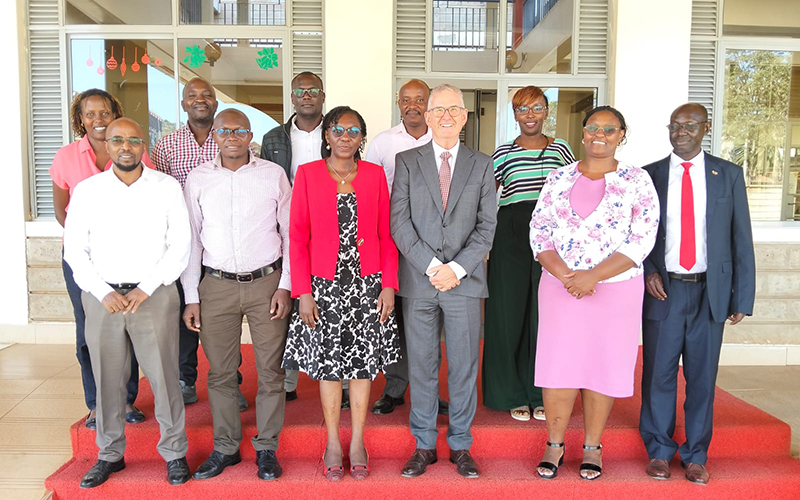
In February 2026, OUK, with support from COL, hosted a Micro-credential Policy and Programme Development Workshop, bringing together experts from academia, industry, and society to develop a holistic policy framework aligned with national standards and labour market needs. Prior to the session, Professor Prinsloo shared insights with OUK’s Management Board on integrating artificial intelligence (AI) and data-informed pedagogies to enhance learner support and learning outcomes in open and online learning. He highlighted how the strategic and ethical use of AI can contribute to more appropriate pedagogical assessment and student support strategies, while also strengthening evidence-based policy implementation.
During the meeting, Professor Prinsloo referenced recent developments in AI and drew on discussions from the National Open University of Nigeria to comment on AI’s potential impact on curricula and instructional design and delivery. These insights fed into the development of the policy framework at the workshop itself.
Following the session, a group of academics from the education, science, and business schools at OUK further met to design and develop the institution‘s first set of micro-credentials.
“By integrating evidence-informed pedagogies and ethical practices of emerging technologies, like generative AI, this work positions the OUK to deliver future-ready, lifelong learning in open education,” said Dr Olivier.
Professor Prinsloo described the session as “extremely fruitful,” emphasising Kenya’s commitment to future-ready education that is responsive, innovative, human-centred and industry-aligned.
COL looks forward to continuing its work with OUK and other institutions around the Commonwealth to advance micro-credentials, strengthen graduate employability, and expand access to quality learning.