
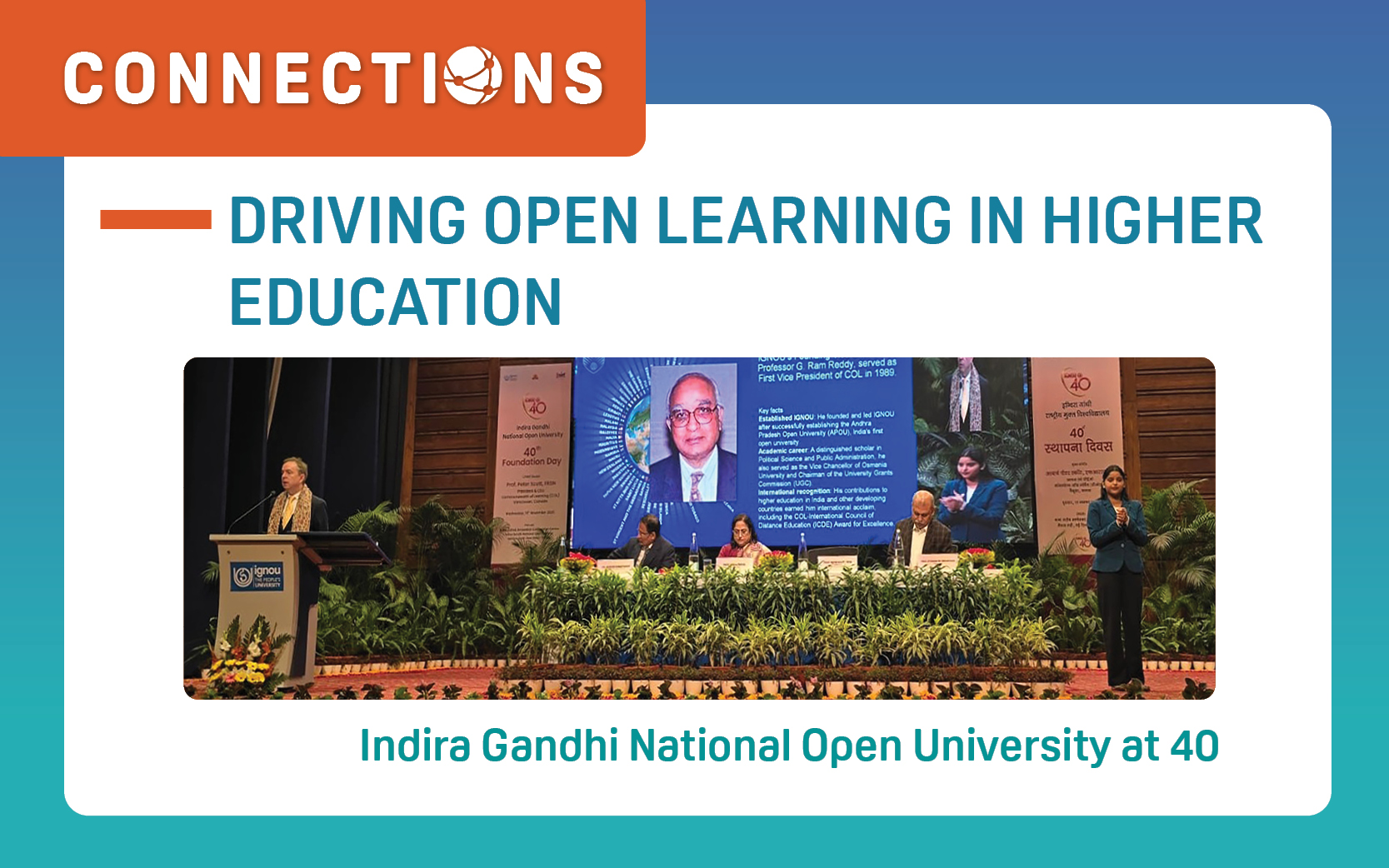
Celebrating four decades of expanding access to higher education through ODL, the Indira Gandhi National Open University (IGNOU) marked its 40th Foundation Day in November 2025, during which Professor Scott joined university leadership in reflecting on IGNOU’s transformative impact on open learning.
Established in 1985, IGNOU is now the world’s largest open university, providing accessible education to millions of students.
As Chief Guest, Professor Scott joined the Vice Chancellor, Professor Uma Kanjilal, along with faculty and leadership, to recognise past achievements and help set the direction for the next phase of digital, inclusive and lifelong learning, while highlighting the importance of equitable access.
During the celebrations, Professor Kanjilal spoke about the institution’s transformative role in providing “anywhere, anytime” higher education to millions and reaffirmed the university’s commitment to open learning. She highlighted the institution’s focus on quality, equity and relevance, emphasising the expansion of micro-credential courses, growing collaborations with ministries, international partnerships, and technology-driven initiatives.
He also recognised the pioneering influence of Professor G. Ram Reddy, IGNOU’s founder and member of COL’s Founding Board of Governors and its first vice president, reflected on the enduring partnership between IGNOU and COL in addressing the global challenge of democratising education.
Emphasising the need to address persistent gaps in access, Professor Scott called for the ethical adoption of AI, supported by strong policy guardrails and a teacher-in-the-loop approach. He also stressed that openness and collaboration are foundational to building resilient education systems, a mission at the heart of COL’s strategy, which prioritises strengthening institutions, supporting national resilience, and ensuring the responsible and ethical adoption of emerging technologies.
Reflecting on the future of digital learning in the Commonwealth, Professor Scott highlighted the need for strong AI policy guardrails, teacher-centred approaches, data sovereignty, and the development of micro-credential frameworks that enable credit exchange and learner mobility. He also reaffirmed COL’s commitment to co-creation, innovation, and advancing open education as a driver of lifelong learning across the Commonwealth.
As IGNOU enters its fifth decade, its commitment to innovation and openness continues to shape higher education in India for a digital, interconnected world, with COL looking to deepen its collaboration in the years ahead.
This story was originally published in the April 2026 issue of Connections. Read the full issue: https://hdl.handle.net/11599/6130.