
By Ms Frances J. Ferreira, Senior Adviser: Women and Girls
During the week of 8–12 September 2025, more than 400 delegates gathered in Gaborone, Botswana, for the Eleventh Pan-Commonwealth Forum on Open Learning (PCF11). In partnership with the Commonwealth of Learning (COL), this triennial forum was co-hosted by the Botswana Ministry of Higher Education and Botswana Open University, under the theme ‘Innovative Open Education: Fostering Resilient Societies for Sustainable Economic Development.’ A key outcome of PCF11 was the adoption of the Gaborone Statement, which outlines seven commitments to advance open and flexible learning across the Commonwealth.
Among the initiatives showcased at PCF11 was the Empowering Women and Girls (EWG) Project, a flagship programme for COL, funded by Global Affairs Canada. With this in mind, the EWG Project advances the second commitment of the Gaborone Statement, ‘Skills for productive and resilient lives — Encourage the expansion of flexible, work-relevant learning for out-of-school youth and adults.’
Ahead of PCF11, the EWG project partners participated in the PCF11 pre-forum seminars, which focused on:
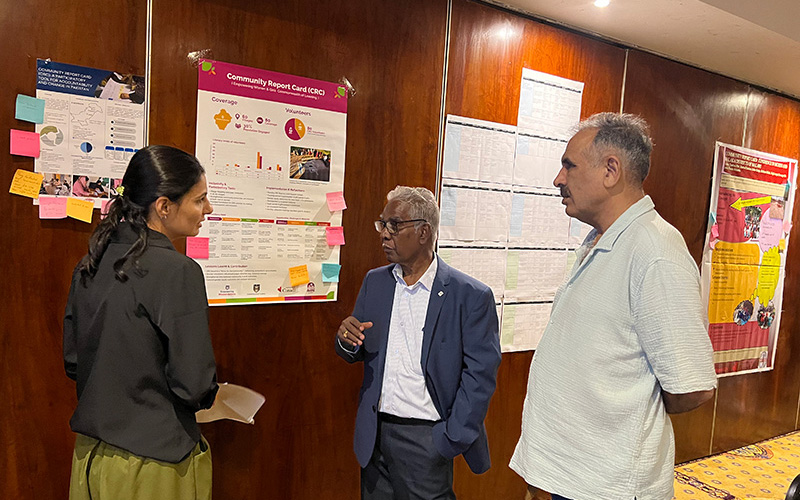
- Assessing the feasibility and lessons learned from Community Report Cards (CRCs) as a community-based accountability tool.
- Reviewing the shared Outcomes Framework to develop a collective understanding of the processes, tools, and evidence required for robust outcome measurement.
- Facilitating peer exchange to strengthen knowledge on data collection, evidence-based planning, and community engagement.
This engagement provided partners with a clear, unified approach to display their work at PCF11 and ensured alignment with the Forum’s priorities. The EWG project made a strong presence at PCF11, presenting five papers that highlighted strategies for inclusive and equitable open education, including:
Professor Philip Uys shared insights in Collaborative Peer Learning for International Course Development in the EWG Project: Challenges and Lessons Learned, highlighting practical approaches to building collaborative and supportive learning environments.
In the session on Monitoring, Assessment and Evidence for Sustaining Communities, which explored tools and methods for continuous improvement in open education. Damodaram Kuppuswami and Frances Ferreira presented their paper, The Role of Monitoring in Sustaining Communities of Learning and Practice, demonstrating how EWG’s monitoring efforts drive project sustainability.
From Pakistan, Samina Afzal presented “Empowering Rural Women through Vocational Training and Secondary Education: A Model for Skills Development and Lifelong Learning”. Her paper highlighted a model implemented in rural Punjab that integrates vocational training with open secondary education. By combining practical skills with formal learning, the project supports women in gaining economic independence, confidence, and opportunities to re-enter education systems. This model closely aligns with the PCF11 sub-theme, ‘Skills Development through Lifelong Open Education.’
Overall, the EWG presentations at PCF11 highlighted how the project’s integrated training and support package not only enhances skills but also strengthens women’s empowerment, resilience, and ability to lead dignified, productive lives.
Over the past two years, the EWG project has achieved significant outcomes, including:
- 60% of women can recall and apply human rights learning.
- 30-45% of men demonstrate gender-equal behaviours.
- 70% of trained women are now employed/self-employed.
- Retention rates are improving 10-20%, and the gender gap is narrowing.
- Farm yields up 40-60%, and women’s incomes are increasing.
- WROs challenge discrimination in 40% of communities.
Maintaining the PCF11 Momentum Beyond the Forum
We must also not end our work at PCF11. The EWG project’s participation in PCF11 provides a solid foundation for sustaining momentum, including:
- Demonstrating scalable models of flexible learning
The project’s blended, community-based, livelihood-relevant, gender-responsive, and climate-informed approach offers a practical and scalable model for delivering flexible, work-relevant learning for out-of-school youth and adults across the Commonwealth. - Strengthening South–South learning
With partners from multiple countries, the project exemplifies how peer learning across the Commonwealth accelerates innovation, improves implementation quality, and fosters knowledge exchange between nations. - Deepening accountability and evidence culture
The use of CRCs and a shared Outcomes Framework ensures that project planning and delivery are grounded in evidence and community feedback, reinforcing transparency and accountability as part of the Commonwealth values. - Inspiring cross-sector collaboration
By addressing livelihoods, climate resilience, gender equality, and community empowerment, the project highlights the value of multidimensional partnerships and demonstrates how integrated approaches can achieve greater impact. - Sustaining the momentum from PCF11 requires documenting learning, sharing results, and celebrating transformative stories.
The EWG project’s ongoing documentation of learning, dissemination of results, and sharing of transformative experiences support the continued implementation of PCF11 commitments and contribute to long-term impact across Commonwealth countries.
The EWG project represents a comprehensive approach to building skills, resilience, and empowerment. Its participation in the Pre-Forum and PCF11 demonstrates how flexible, work-relevant learning can positively transform lives while supporting COL’s commitment to fostering productive, resilient, and inclusive societies.