

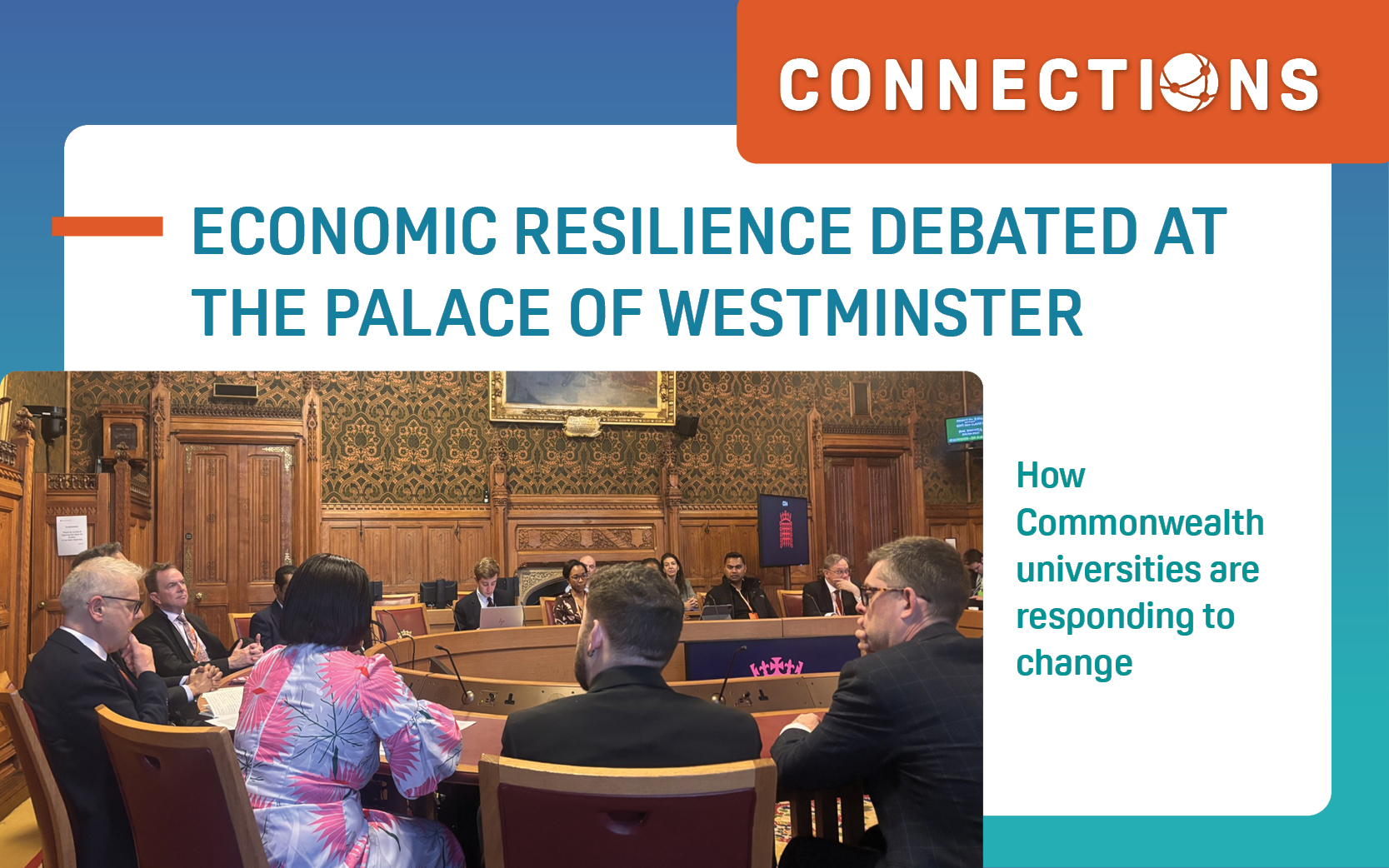
The focus on economic resilience and its advancement across the Commonwealth through education brought the Association of Commonwealth Universities (ACU) and COL together on 11 March 2026. Held at the House of Lords in the Palace of Westminster in London, UK, the Rt Honourable Lord Kamall of Edmonton opened the meeting of the All-Party Parliamentary Group, which is composed of members of all political parties and provides a platform for parliamentarians to discuss and promote issues of shared interest.
The meeting focused on education, skills, and mobility for economic resilience. Professor Colin Riordan, Secretary-General and Chief Executive of ACU, spoke about this topic and introduced ACU Fellows, who shared their work with the Lords, showing how “thought leadership mobility” helps connect universities across the Commonwealth. ACU Fellows are academic and professional staff from member universities who join fellowships to encourage knowledge exchange and collaboration.
ACU serves as a vital bridge for academic and professional growth across international borders, with a particular focus on low- and middle-income countries. By modernising curricula and teaching standards, the organisation helps ensure that the workforce remains adaptable and competitive in an ever-changing global market. As technology advances and economic priorities shift, job skills and requirements are also changing quickly. Universities play an important role in helping students develop critical thinking, adaptability, and lifelong learning skills so they can succeed in careers that keep evolving.
During the meeting, Professor Scott underlined education, skills, and mobility as key priorities for the UK and other Commonwealth governments. ACU is currently working with COL to map the landscape, aspirations, and challenges facing Commonwealth universities in delivering education aligned with labour-market needs.
In response to strong industry demand for skills-based learning, a joint ACU/COL team has surveyed 60 universities across five Commonwealth regions and identified nine case studies that represent a wide range of institutional responses. This work is helping build a deeper understanding of what Commonwealth universities can offer and deliver.
While most universities offer skills-oriented courses at both undergraduate and postgraduate levels, professional programmes such as Computing, Business & Management, Engineering, Medicine, and Education are still often viewed as “academic” from an industry perspective. The study also notes that universities tend to prioritise partnerships with local and regional employers. At the same time, there remains a strong reliance on in-person teaching, although blended, hybrid, and online learning are beginning to make a noticeable impact in the findings.
The House of Lords meeting provided a valuable opportunity to highlight challenges in skills development and employability to UK leaders, as well as issues shared by Commonwealth countries. As the project continues, ACU and COL will move from analysis to practical recommendations for the whole Commonwealth. These steps will help universities better match labour market needs and support students as they enter a fast-changing global economy.
This story was originally published in the April 2026 issue of Connections. Read the full issue: https://hdl.handle.net/11599/6130