

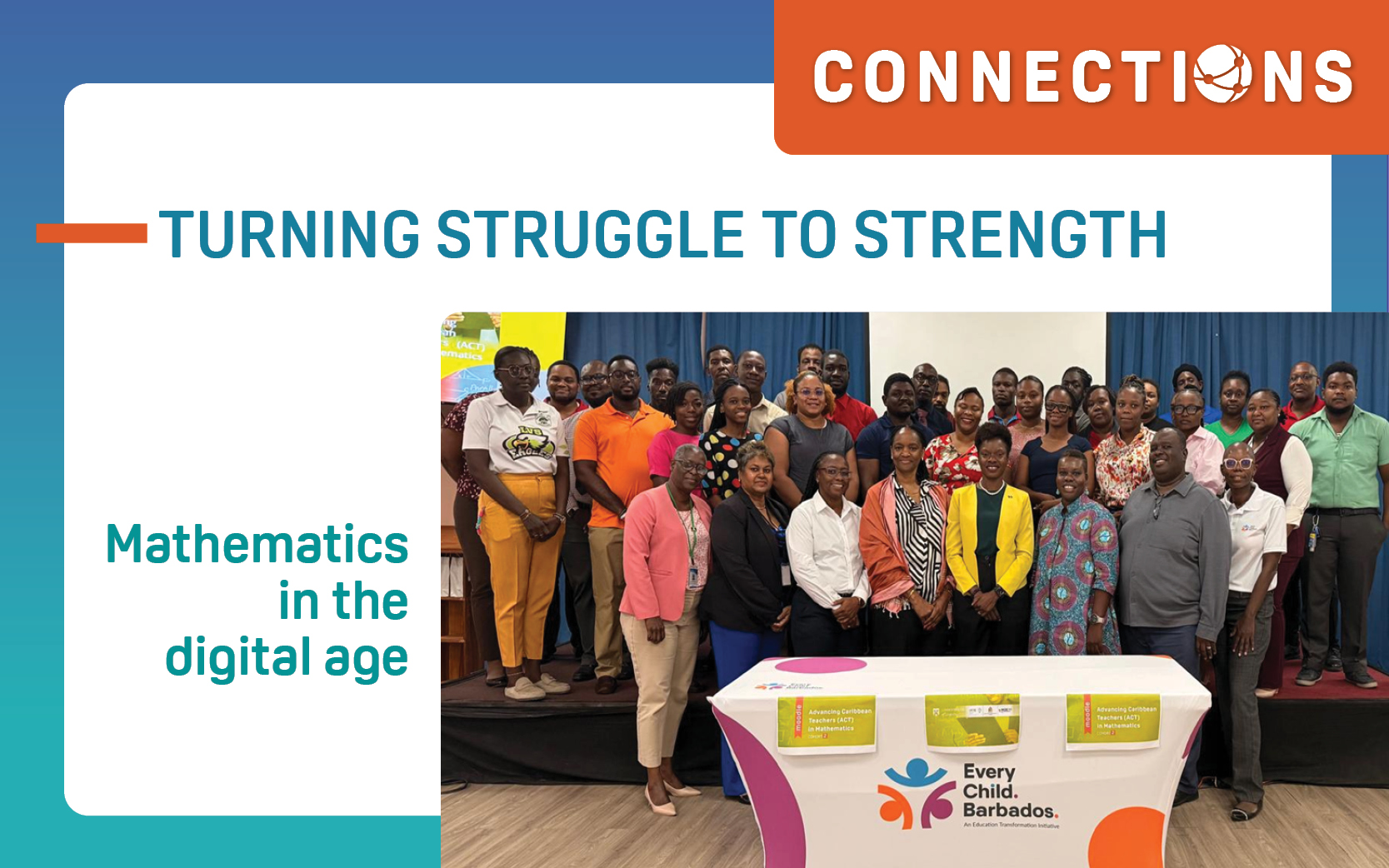
Mathematics education in the Caribbean is top of mind for educators. Ongoing underperformance at the secondary level, alongside consistently weak outcomes in national numeracy assessments, can narrow the pathways available to learners, particularly into STEAM fields: science, technology, engineering, the arts, and mathematics. In response, the Caribbean Examinations Council (CXC) has been implementing reforms to strengthen the curriculum, enhance teacher development, and better leverage technology to support competency-based learning.
In March, CXC brought together educators from across the region for its first Regional Education Conference on Literacy and Numeracy, under the theme Navigating the Digital Age: Rethinking Teaching, Learning and Assessment. The conversations reflected openness to doing things differently and to being more innovative.
An Initiative Practical in Design
Working alongside these efforts, COL, through its network, the Virtual University for Small States of the Commonwealth (VUSSC), has been engaging directly with education ministries from across the Caribbean. In 2024, COL launched, through this network, the Advancing Caribbean Teachers (ACT) in Mathematics initiative with three small island developing states: Saint Lucia, St Kitts and Nevis, and St Vincent and the Grenadines. By 2025, the expansion to include Barbados, Dominica, and Grenada pointed to a commitment and momentum in the region to strengthen mathematics teaching and learning.
The ACT initiative is intentionally practical in its design. It builds on a professional development model that combines in-person workshops with self-paced learning using open educational resources on a dedicated, contextually designed learning management platform, along with online sessions within communities of practice across the participating countries. What has emerged is not just a training model, but a space where teachers can test ideas and learn from one another in real time.
At its launch in November 2025, secondary school teachers from Barbados, Dominica, and Grenada spent two intensive days exploring strategies such as the Concrete–Pictorial–Abstract Practice (CPA–P) approach, which strengthens classroom dialogue and leverages technology to make abstract concepts more visible and accessible — leading to improved student engagement and understanding. As COL consultant Dr Lois George of The University of the West Indies, Mona, noted, “When teachers use CPA–P well, students are not just memorising procedures; they are building deep, connected understanding that they can carry into any STEAM pathway.”
Inclusive Learning Practices
A key development from the initiative has also been the ACT in Mathematics Webinar Series and its wider community of practice, developed with regional partners. Since 2025, these monthly sessions have brought together not only teachers, but also coaches, curriculum officers, parents, and even students. These stakeholders have explored a range of topics, including math anxiety and number sense, as well as the use of digital tools for formative assessment. Over time, this has contributed to more inclusive teaching practices and improved confidence in mathematics across stakeholders. It has also helped to move mathematics out of the “exam-only” space and into a broader culture of shared responsibility.
For Dr Schontal Moore, COL Adviser: VUSSC, this work captures COL’s broader mandate and mission in the region through the ACT in Mathematics project. “Our goal is to stand alongside small states as they expand access to high-quality, flexible learning. By starting with mathematics and building communities around teachers and families, we are helping to strengthen learning outcomes and secure a more innovative, inclusive, and resilient future for Caribbean learners.”
Taken together, these efforts, led regionally by CXC and supported by COL, are empowering teachers with practical tools, innovative ways of approaching their challenges, and the development of a strong professional community that extends beyond national borders. Over time, these approaches are laying the foundation for sustainable improvements in mathematics, ensuring that students are not only prepared for assessments but also equipped with the skills and confidence to excel.
This story was originally published in the April 2026 issue of Connections. Read the full issue: https://hdl.handle.net/11599/6130.