

The Youth Robotics for Blue-Green Resilience and Prosperity Project is a Commonwealth of Learning (COL) pilot in the Caribbean that brings young people from across the region together to explore real development challenges and how technology, research, communication, and advocacy can contribute to practical solutions. Through regional collaboration and hands-on learning, the initiative strengthens future-ready skills while giving Caribbean youth an active role in shaping a more resilient future.
To accommodate the high level of interest among young people, the project is being delivered through two complementary youth streams. The first brings young people together in Robotics Design and Prototype Teams to research shared Caribbean challenges and develop potential robotics-enabled solutions. The second, a Research, Media and Advocacy Team, gives young people a platform to investigate many of the same blue-green resilience issues and communicate their perspectives through research, digital storytelling and advocacy. Together, the streams connect technical innovation with the research, communication, and youth advocacy needed to build broader public understanding and support for practical solutions.
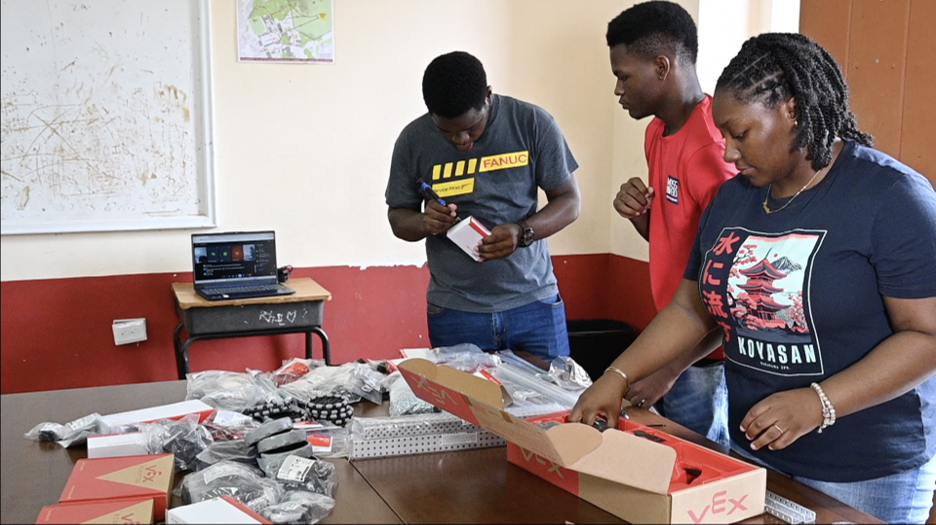
Young innovators take inventory of newly arrived robotics components as they prepare to design and develop their prototypes for COL’s Pan-Caribbean Youth Robotics Innovation Project. Their work will be showcased at the CHOGM 2026 Youth Forum, where they will present their ideas and potential solutions to regional challenges to Commonwealth leaders.
Building across blue waters
The prototype groups meet online every week and work as one virtual innovation community. With seven design teams focused on different blue-green solutions, the robotics design and prototype cohort is developing responses to challenges communities face in difficult or hazardous conditions. These include sargassum harvesters for use on water and onshore, wave-energy and coastal protection devices, and a rover for soil assessment and farm security.
The teams also meet with their mentors, virtually and in person, to refine designs, code, troubleshoot, source materials, and construct prototypes. Through this hands-on process, young innovators are turning their ideas into potential solutions to real-world challenges.
Turning research into advocacy
The research, media and advocacy team plays an equally practical role. In weekly sessions, young people learn to investigate evidence, create flyers, organise and host webinars, and communicate complex themes to their peers and communities. Their six focus areas span biodiversity, ocean health, assistive robotics, water conservation, coastal resilience and food security. Insights from the youth-led webinars will be published in a resource written by young people, for young people, to advance public understanding of blue-green issues and potential robotics and AI solutions.
Mentoring young innovators
An experienced mentor network based in Antigua and Barbuda, Barbados, Belize, Jamaica and Trinidad and Tobago brings expertise in robotics coaching, electrical and computer engineering, mechatronics, automation, coding, product design, educational leadership and entrepreneurship into the learning cycle. Their work is both technical and human: coaching young people to question assumptions, listen to one another, recover from failed tests, meet deadlines and communicate the purpose of their designs.
The mentor network includes:
- Shawn Hoyte (Barbados): Led Barbados teams to the 2026 VEX World Championships and helped establish the national Battle of the Bots competition.
- Daniel Devonish (Barbados): VEX V5 coach whose work contributed to an international Sportsmanship Award.
- Jamie Lee Usher (Belize): President of the Belize Robotics Federation and mentor to FIRST Global medal-winning teams.
- Diandra Heppell Sukhu (Jamaica): Coached World Robot Olympiad national champions and DECA Idea Challenge winners.
- MarcAnthony Eaton (Jamaica): Coached FIRST Tech Challenge and FIRST
- Global award-winning teams.
- Dr Jorrel Bisnath (Trinidad and Tobago): Brings research and teaching experience in mechatronics, automation and entrepreneurship at the University of Trinidad and Tobago.
- Ronnie Bickramdass (Trinidad and Tobago): Brings extensive experience in engineering laboratories, prototyping and judging for FIRST LEGO League.
- Paul Nicholls (Trinidad and Tobago): Contributes expertise in classroom and VEX education.
- Denesha Grant (Trinidad and Tobago): Brings experience in computer science teaching and digital media.
- Tijah Myers (Trinidad and Tobago): Contributes practical expertise in automation, Arduino, sensors and electronics.
A call to Commonwealth leaders at CHOGM 2026
The youth participants are joining international and regional stakeholders in Antigua and Barbuda for the Commonwealth Heads of Government Meeting (CHOGM) 2026. In collaboration with Deutsche Gesellschaft für Internationale Zusammenarbeit (GIZ), the young innovators and their mentors will showcase their prototypes and solutions at the Youth Forum on 3 November, from 1:00 to 3:00 pm. They will also engage with industry professionals to explore career opportunities in the blue and green economies and attend the launch of UNICEF’s Green Rising Grant Fund.
Their message to Commonwealth leaders is clear: young people must have a voice in shaping solutions to today’s challenges, with their research, ideas and innovations informing decisions, particularly in the blue and green economies. By drawing on the orange economy through creative practice, storytelling, digital production and entrepreneurship, these young innovators are turning ideas into practical solutions. They are not waiting for an invitation to shape the future. They are demonstrating what they can contribute today.
Taking it into classrooms
The pilot is extending its reach beyond the young people enrolled in the programme by equipping teachers with the skills and confidence to introduce coding and robotics into their classrooms.
A complementary 12-week Introductory Coding and Robotics Course for Teachers began on 28 September 2026, with all 500 places filled within 48 hours of the announcement. Participants are seeking practical teaching approaches, professional development opportunities, skills enhancement and, where applicable, support in meeting professional re-licensing requirements. Through hands-on learning in basic coding, Scratch, ScratchJr and VEX robotics platforms, alongside classroom management and lesson design, teachers are developing the skills to integrate problem-solving, experimentation and creativity into everyday teaching.
Pre-course responses from 484 teachers highlight the need for practical training: nearly 75% had not integrated coding and robotics into their teaching, while 60% had no prior robotics experience.
Future skills for lasting change
By connecting youth innovation, research and advocacy with mentorship and teacher development, the pilot is building a foundation for lasting change. It aims to strengthen the Caribbean’s capacity to develop home-grown solutions, equip the next generation with future-ready skills, and contribute to more resilient communities and sustainable blue-green economies.[/vc_column_text][/vc_column][/vc_row]